
Laser to Remove Dark Spots: Types, Cost, Recovery, and Results

Dr. Matthew Olesiak, MD, is the Chief Medical Director at SANESolution, a renowned wellness technology company dedicated to providing evidence-based solutions for optimal living. Dr. Olesiak earned his medical degree from the prestigious Jagiellonian University Medical College in Kraków, Poland, where he developed a strong foundation in medicine.
Using a laser to remove dark spots is the most effective option when creams, serums, or other topical treatments. Using concentrated beams of light energy, lasers target and break apart excess melanin, the pigment responsible for brown spots, age spots, and sun spots, so your body can naturally clear the fragments over the following weeks. I’ve watched patients spend years layering on cosmetic products with minimal results, only to see topical products fall short, then achieve 70-80% improvement after just 2-3 laser sessions.
But “laser” is a broad term. There are at least four distinct categories of laser and light-based devices used for dark spot removal, and choosing the wrong one for your skin tone or type of hyperpigmentation can actually make hyperpigmentation issues worse. There are different types of laser therapy for skin discoloration, and this guide breaks down exactly how each technology works, what it costs, the real recovery timeline, who should and shouldn’t get treated, and what alternatives exist when lasers aren’t the right fit.
How Do Lasers Actually Remove Dark Spots?
The basic science behind laser treatment for dark spots is surprisingly straightforward. A laser emits focused light energy at a specific wavelength that’s absorbed preferentially by melanin, the pigment that gives dark spots, brown spots, sun spots, and age spots their color (American Academy of Dermatology). When melanin absorbs this laser energy, it heats up rapidly and shatters into microscopic particles.
Think of it like this: the excess melanin in a dark spot acts like a tiny target. The laser beam passes through the surrounding skin without affecting it, then gets absorbed by the concentrated pigment. The pigmented cells break apart, and your body’s lymphatic system sweeps up the debris over the next several weeks. New skin gradually replaces the damaged outer layer, leaving a more even skin tone behind with fewer pigment irregularities.
What makes modern laser skin treatment and laser resurfacing technology highly precise is wavelength selection. Different wavelengths penetrate to different depths within the skin layers (from the superficial epidermis down to the deeper dermis). Some laser skin resurfacing devices use visible light wavelengths, while others penetrate the deeper layers of skin tissue. Shallow pigmentation caused by sun exposure responds well to shorter wavelengths, while deeper hyperpigmentation from hormonal changes or post-acne marks may require wavelengths that reach further into skin tissue.
The other critical variable is pulse duration. Older lasers delivered energy in relatively long pulses, which generated more heat and increased the risk of damaging surrounding skin. Modern Q-switched and picosecond lasers fire in billionths or trillionths of a second, confining the thermal damage almost exclusively to the pigmented cells with minimal collateral damage to surrounding tissue.
Types of Lasers for Brown Spot Removal (And Which One You Actually Need)
Not all lasers are created equal for dark spot removal. The right choice depends on your skin color, the type and depth of your pigmentation, how much downtime you can tolerate, and your budget. Here’s what you need to know about each major category.
Intense Pulsed Light (IPL)
Technically, IPL isn’t a laser, it’s a broad-spectrum light device that emits multiple wavelengths simultaneously. It works well for treating sun spots, age spots, and liver spots on lighter skin tones (Fitzpatrick types I-III). IPL targets the melanin in superficial brown spots while also addressing redness and broken capillaries, making it a popular choice for correcting uneven skin tone through skin resurfacing and rejuvenation.
The downside? IPL is less precise than true lasers. Because it emits a wide band of light wavelengths, there’s more energy absorbed by the surrounding skin, which means a higher risk of burns and post-inflammatory hyperpigmentation on darker skin. If you have medium to dark skin, IPL is generally not the best option for brown spot removal.
Best for: Fair skin with scattered sun spots, general skin tone evening
Sessions needed: 3-5, spaced 3-4 weeks apart
Downtime: Minimal, mild redness for a few hours to 1 day
Cost per session: $300-$600
Q-Switched Lasers (Nd:YAG, Ruby, Alexandrite)
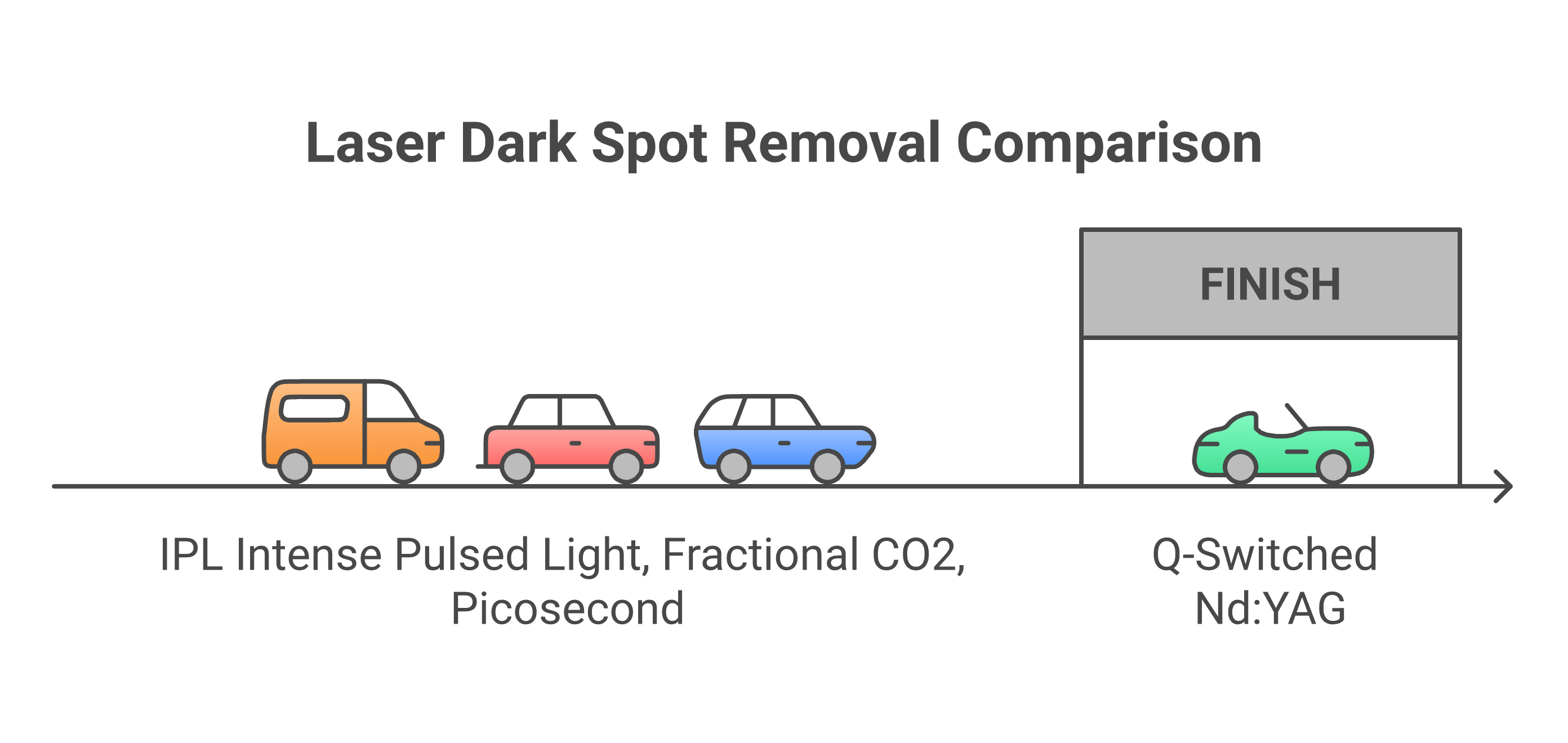
Q-switched lasers are the workhorses of pigment removal in dermatology, and a single laser treatment session with these devices can clear spots that topicals never touch. They deliver extremely short, high-intensity pulses (nanoseconds) that shatter melanin deposits without generating excessive heat in the treated area. For persistent brown spots, Q-switched technology remains the gold standard. The Q-switched Nd:YAG is particularly important because it operates at 1064nm wavelength, which is safer for darker skin tones, a major advantage over IPL and many other laser systems.
These lasers remove brown spots by creating a photoacoustic effect: the rapid energy pulse literally vibrates the pigment apart, rather than just burning it. This makes Q-switched technology highly effective for stubborn brown spots and age spots, sun damage, and even some forms of melasma that haven’t responded to topical treatments.
Best for: All skin tones (especially Fitzpatrick IV-VI with Nd:YAG), deep pigmentation, stubborn spots
Sessions needed: 2-4 for most age spots; 4-8 for deeper pigmentation
Downtime: 3-7 days of darkening, crusting, then peeling
Cost per session: $400-$800
Picosecond Lasers (PicoSure, PicoWay)
Picosecond lasers represent the newest advancement in laser technology for dark spot removal. They fire pulses measured in trillionths of a second, roughly 100 times faster than Q-switched lasers. This ultra-short pulse duration shatters pigment into even smaller particles, which your body clears more efficiently. The result? Fewer sessions needed and less risk to the treated skin.
In my experience, picosecond lasers are becoming the preferred choice for patients who want the fastest results with minimal downtime. A 2019 study in the Journal of Dermatologic Surgery found that picosecond lasers achieved greater than 75% clearance of pigmented lesions in 76% of patients after just 1-2 sessions.
Best for: All skin tones, especially those who want fewer sessions and faster recovery
Sessions needed: 1-3 for most brown spots
Downtime: 1-3 days of mild redness and slight darkening
Cost per session: $500-$1,200
Fractional Lasers (Fraxel, CO2 Fractional)
Fractional lasers take a different approach. Unlike the pigment-targeting devices above, ablative laser resurfacing with fractional technology works by controlled skin resurfacing. Instead of targeting pigment directly, they create thousands of microscopic columns of injury in the skin, treating a “fraction” of the skin’s surface at a time. This triggers an aggressive healing process where the body replaces damaged tissue with new skin, effectively removing the top layer and any pigment trapped within it. This type of laser skin resurfacing creates dramatic skin resurfacing results.
Fractional lasers like the Fraxel are particularly useful when dark spots come packaged with other aging concerns, fine lines, wrinkles, rough skin texture, and enlarged pores. They’re doing double duty: removing pigment while simultaneously stimulating collagen production, which helps reduce wrinkles and fine lines alongside the brown spot removal. The added benefit of collagen remodeling gives treated skin a more radiant complexion.
The tradeoff is more significant downtime. Fractional laser resurfacing produces visible redness, swelling, and peeling that can last 5-10 days. But for patients dealing with widespread sun damage across the entire face, one full face treatment with a fractional laser can accomplish what might take 5-6 sessions with a pigment-specific device.
Best for: Sun damage combined with aging concerns, widespread discoloration, skin texture improvement
Sessions needed: 1-3 for non-ablative; 1-2 for ablative CO2
Downtime: 5-10 days (significant redness and peeling)
Cost per session: $700-$1,500+
Laser Comparison Table
| Laser Type | Best Skin Tones | Avg. Sessions | Downtime | Cost/Session | Effectiveness |
|---|---|---|---|---|---|
| IPL | Fair (I-III) | 3-5 | 0-1 days | $300-$600 | Good for superficial spots |
| Q-Switched | All (I-VI) | 2-4 | 3-7 days | $400-$800 | Excellent for deep pigment |
| Picosecond | All (I-VI) | 1-3 | 1-3 days | $500-$1,200 | Fastest clearance |
| Fractional | Fair-Medium (I-IV) | 1-3 | 5-10 days | $700-$1,500 | Best for aging + spots |
Are You a Good Candidate for Laser Dark Spot Removal?
Laser therapy works exceptionally well for most people with unwanted dark spots, but it’s not the right solution for everyone. Here’s how to assess whether you’re a strong candidate.
Ideal Candidates
- Sun spots and age spots caused by sun exposure and normal aging, which are the most responsive to laser treatment
- Post-inflammatory hyperpigmentation from healed acne, injuries, or prior skin conditions (once the underlying issue has resolved)
- Liver spots on the hands, arms, chest, or face
- Patients with realistic expectations who understand that multiple sessions may be needed and results develop over weeks
- People committed to sun protection after treatment (this is non-negotiable for maintaining results)
Who Should Use Caution
- Darker skin tones (Fitzpatrick V-VI): Not a dealbreaker, but the choice of laser matters enormously. Nd:YAG and certain picosecond lasers are safe options, while IPL and some fractional lasers carry a higher risk of worsening pigmentation
- Active melasma: Laser therapy for melasma is controversial. While certain low-fluence Q-switched protocols show promise, aggressive laser therapy can trigger a melasma flare that’s worse than the original condition. A certified dermatologist experienced with melasma should guide this decision. Always look for a board certified dermatologist who has treated your specific skin concerns before
- Active acne or open wounds: The treatment area needs to be clear of active breakouts and healed before laser treatment begins
- Recent tanning or sun exposure: You’ll need to avoid sun for at least 4-6 weeks before treatment to reduce risk
- Pregnancy: Most dermatologists recommend waiting until after delivery and breastfeeding
- Certain medications: Accutane (isotretinoin) users typically need to wait 6 months after stopping. Photosensitizing medications like certain antibiotics increase burn risk
If you’re unsure whether laser treatment is appropriate for your specific type of dark spots, start with a professional consultation where your skin type, skin color, spot depth, and medical history can be properly evaluated.
The Treatment Journey: What to Expect Before, During, and After
Before Your Session
Preparation begins 2-4 weeks before your appointment. You’ll be asked to stop using retinoids, retinol products, and any exfoliating acids (glycolic acid, salicylic acid). Avoiding sun exposure during this period is critical because tanned skin absorbs more laser energy, increasing the risk of burns and post-inflammatory hyperpigmentation.
Some practitioners prescribe a short course of hydroquinone or other skin-lightening agents to pre-treat the area, especially for patients with darker skin. A local anesthetic cream (typically lidocaine-based) is often applied 30-60 minutes before the procedure to minimize mild discomfort.
During the Procedure
The procedure itself is performed on an outpatient basis and takes anywhere from 15 minutes (for a few isolated spots) to 45 minutes for a full face treatment. You’ll wear protective eye shields, and the practitioner will guide the laser handpiece across the treatment area.
What does it feel like? Most patients describe the sensation as a quick snapping feeling, like a rubber band being flicked against the skin. The mild discomfort is tolerable for most people, especially those with darker skin who’ve likely tried more painful treatments before. For larger areas, a cool compress or cold air device is used between passes to keep discomfort manageable.
You won’t see an immediate difference in the spots themselves. In fact, treated brown spots typically look darker immediately after the session. This is completely normal and actually a good sign. It means the laser energy was absorbed by the pigment.
After Treatment: The Healing Process Day by Day
Day 1-2: Expect redness and mild swelling in the treated area, similar to a sunburn. Apply a cool compress as needed to promote healing. The dark spots will appear notably darker, sometimes almost black.
Day 3-5: The darkened spots begin to form thin, dry crusts that look like coffee grounds sitting on the skin’s surface. Do not pick at them. Apply a thin layer of petroleum jelly or antibiotic ointment as directed.
Day 5-10: The crusted spots naturally flake off, revealing new skin underneath that’s pink or slightly lighter than the surrounding area. This is where most patients begin to see the improvement.
Week 2-4: The pinkness fades and skin color begins to normalize. The full result won’t be visible for 4-8 weeks as the body continues clearing residual pigment particles.
Following your dermatologist’s aftercare instructions for post treatment care during this healing process is essential. Proper post treatment habits determine whether you keep your results or lose them. The biggest mistakes I see patients make? Going back in the sun too early and skipping sunscreen. Both can erase your results entirely.
Recovery Time and Aftercare That Actually Matters
Recovery time varies significantly depending on which laser was used. Here’s a realistic breakdown:
- IPL: Return to normal activities the same day. Makeup can usually be applied within a few hours. The treated spots darken and fade over 1-2 weeks
- Q-Switched: Plan for 5-7 days of visible darkening and crusting. Most people feel comfortable going out in public after the crusts fall off (day 5-7)
- Picosecond: Minimal downtime, 1-3 days of slight darkening and redness. Many patients return to work the next day
- Fractional laser resurfacing: The most aggressive recovery. Expect 7-10 days of redness, swelling, and peeling before skin looks presentable
Critical Aftercare Rules
- Practice diligent sun protection and apply sunscreen religiously. Use a broad spectrum sunscreen with a sun protection factor of at least 30, SPF 50 is even better. Reapply every 2 hours when outdoors. This needs to continue for at least 3-6 months post-treatment and ideally becomes a permanent habit
- Avoid direct sun. Avoiding sun exposure is the single most important factor in maintaining your results. Wear wide-brimmed hats and seek shaded areas during peak UV hours
- Don’t pick or scrub. Let the crusted spots fall off naturally. Picking increases scarring risk
- Skip active ingredients. No retinoids, vitamin C serums, glycolic acid, or exfoliants for at least 1-2 weeks after treatment (or as long as your provider advises)
- Moisturize gently. Stick to gentle cleansing with a mild, fragrance-free cleanser and apply a fragrance-free moisturizer to keep treated skin hydrated during the healing process
- No hot showers, saunas, or intense exercise for the first few days because heat can worsen swelling and redness
How Much Does Laser Treatment for Dark Spots Cost?
The cost of laser treatment for dark spots ranges from $200 to $1,500 per session, with most patients paying between $400 and $800. The total investment depends on several factors:
- Type of laser: IPL tends to be the least expensive ($300-$600), while fractional laser resurfacing and picosecond lasers cost more ($700-$1,500)
- Size of the treatment area: Treating a few isolated spots on the hands costs less than a full face treatment
- Number of sessions: Most people need 2-5 sessions for optimal results. At $500 per session, that’s a total investment of $1,000-$2,500
- Geographic location: Practices in major cities (New York, Los Angeles, Miami) charge 20-40% more than those in smaller markets
- Provider experience: A dermatologist with extensive experience in pigment disorders may charge more than a general aesthetician, but the reduced risk of complications often justifies the premium
This is a cosmetic procedure, so health insurance won’t cover it. According to patient-reported data on RealSelf, some practices offer package pricing that saves 15-25% versus paying per individual session, which is worth asking about during your consultation.
For patients seeking more affordable alternatives, over-the-counter and prescription topical treatments can also lighten dark spots over time, though results take longer to appear.
Potential Risks and Side Effects You Should Know
Laser treatment for dark spots is generally safe when performed by an experienced provider, but no procedure is risk-free. When performed correctly, laser therapy is highly effective and achieves lasting results, but you need the right provider to get the best results and minimize scarring risk. Understanding the potential side effects and knowing how to protect your skin helps you make an informed decision.
Common Side Effects (Expected and Temporary)
- Redness: Universal after any laser treatment. Ranges from mild pinkness (IPL) to significant redness lasting up to a week (fractional)
- Swelling: Most noticeable in the first 24-48 hours, especially around the eyes. Usually resolves within 2-3 days
- Darkening of treated spots: Spots temporarily get darker before they flake off. This alarms patients but is expected
- Crusting and peeling: Part of the normal healing process as the body sheds damaged pigmented cells
Less Common but More Serious Risks
- Post-inflammatory hyperpigmentation (PIH): Ironically, laser treatment meant to eliminate brown spots can sometimes trigger new darkening, especially those with darker skin tones. This is why laser selection and proper settings are critical for Fitzpatrick types IV-VI, as documented in peer-reviewed dermatology research
- Hypopigmentation: The treated area becomes lighter than the surrounding skin. More common with aggressive settings or repeat treatments in the same spot
- Scarring: Rare with modern lasers but possible, especially if aftercare instructions aren’t followed or the operator uses inappropriate settings
- Infection: Any procedure that disrupts the skin barrier carries a small infection risk. Following proper wound care minimizes this
- Burns: Most likely when IPL is used on tanned or darker skin, or when laser settings are too aggressive
The risk of serious complications drops dramatically when you choose a provider who has specific experience treating your skin type and your particular kind of pigmentation. A consultation should include a discussion of whether your dark spots need medical evaluation before any cosmetic treatment begins, ruling out skin cancer or other skin conditions is always the first step.
Laser Treatment vs. Other Dark Spot Removal Options
Lasers aren’t the only game in town. Each approach has different benefits and tradeoffs. Here’s how they compare to other approaches for treating hyperpigmentation, so you can decide which option, or combination, makes the most sense for your situation.
Chemical Peels
A chemical peel uses acids (glycolic acid, trichloroacetic acid, or salicylic acid) to remove the top layer of skin where pigment is concentrated. Superficial peels are affordable ($100-$300) and require minimal downtime, but they’re less targeted than lasers and typically need 4-6 sessions to fade dark spots. Medium-depth peels are more effective but come with up to a week of peeling and redness. Chemical peels work well for mild, widespread discoloration and are safer for some darker skin types than certain lasers.
Topical Treatments
Prescription hydroquinone (2-4%), topical retinoid creams, niacinamide, alpha arbutin, and vitamin C serums can lighten dark spots over 8-12 weeks of consistent use. They’re the most affordable option and work well for mild hyperpigmentation. However, they require patience and consistency. Many patients use topical treatments to maintain results after laser treatment.
Microneedling
Microneedling creates controlled micro-injuries that stimulate collagen production and can improve skin texture and pigmentation. When combined with topical lightening agents (a technique called “micro-channeling”), results can rival mild laser treatments. It’s generally safe for all skin tones and costs $200-$700 per session, but 4-6 sessions are typically needed.
Cryotherapy
Liquid nitrogen applied directly to individual dark spots freezes and destroys the pigmented cells. It’s quick, inexpensive ($100-$300), and works well for isolated sun spots. However, there’s a significant risk of leaving a light spot (hypopigmentation) behind, especially on darker skin.
Comparison Summary
| Treatment | Effectiveness | Cost Range | Sessions | Downtime | Safe for Dark Skin? |
|---|---|---|---|---|---|
| Laser (Q-switched/Pico) | Excellent | $400-$1,200/session | 2-4 | 1-7 days | Yes (with right laser) |
| Chemical Peel | Good | $100-$500/session | 4-6 | 1-7 days | Moderate |
| Topical Creams | Moderate | $20-$150/month | Daily use | None | Yes |
| Microneedling | Good | $200-$700/session | 4-6 | 1-3 days | Yes |
| Cryotherapy | Moderate | $100-$300 | 1-2 | 1-2 weeks | No |
For a deeper look at all available methods to fade dark spots, including home remedies and prescription options, we’ve covered those extensively in a separate guide.
How to Maintain Results After Laser Treatment
Getting the spots removed is only half the equation. Dark spots are caused by sun exposure, hormonal changes, and normal aging, all factors that don’t stop after your laser appointment. Without proper maintenance, new spots will form and old ones can return.
Here’s what actually works long-term to protect your investment and maintain healthier skin:
- Daily sunscreen, every single day. Apply sunscreen with a sun protection factor of at least 30, even on cloudy days when UVA and UVB rays still penetrate. Ultraviolet (UV) radiation is the number one cause of new brown spots and sun damaged skin according to the Skin Cancer Foundation
- Incorporate brightening agents into your routine. Products containing niacinamide, vitamin C, or alpha arbutin help suppress new melanin production. As skin ages, melanin production becomes less predictable. Think of brightening agents as maintenance therapy that helps reduce the appearance of new spots and preserve your skin’s overall appearance
- Annual touch-up sessions. Many dermatology patients return once a year for a quick maintenance session to address any new spots before they accumulate. This approach yields a better outcome and is far more cost-effective than waiting until you need a full course again
- Protective clothing. Hats, UV-protective clothing, wearing sunscreen daily, and shade-seeking behavior make a bigger difference than most people realize. Sun protection goes beyond sunscreen
- Avoid tanning beds entirely. This should go without saying, but artificial UV exposure from tanning beds is just as damaging as natural sunlight for pigmentation. Any sunlight on unprotected skin triggers new melanin production
If you’re dealing with dark spots that developed after age 60, a combination approach (laser treatment followed by consistent topical maintenance) tends to deliver the most lasting results. The aging skin produces melanin less predictably, making ongoing care especially important for maintaining rejuvenated skin and a radiant complexion.
At-Home Laser Devices vs. Professional Treatment
At-home IPL and laser devices (like the Silk’n SensEpil or NIRA skincare laser) have become popular for treating brown spots and skin discoloration without office visits. These consumer devices operate at much lower energy levels than professional equipment, which makes them safer for unsupervised use but also significantly less effective.
For mild, superficial sun spots, a home IPL device can produce modest improvement over 8-12 weeks of consistent use. But for deeper pigmentation, stubborn age spots, or any hyperpigmentation issues on darker skin, professional laser treatment delivers faster and more predictable results. The risk of burns or worsening pigmentation from using an at-home device incorrectly on the wrong skin type is a genuine concern.
My take: at-home devices are fine as a maintenance tool between professional sessions, but they shouldn’t replace a proper evaluation and treatment by a qualified dermatologist. If your dark spots haven’t responded to topical treatments, professional laser therapy is likely what you need.
How to Choose the Right Provider
The laser device matters less than the person operating it. An experienced provider who selects the right laser type, correct wavelength, and appropriate energy settings for your skin color and pigmentation depth will achieve far better results than someone with a better device and less experience.
When choosing a provider for laser dark spot removal, ask these questions during your consultation:
- How many years have you been performing laser treatments for pigmentation?
- Which laser do you recommend for my specific skin tone and type of spots, and why?
- Can I see before-and-after photos of patients with a similar skin type?
- What is your protocol if post-inflammatory hyperpigmentation occurs after treatment?
- Do you offer test spots before committing to a full treatment session?
A provider who cannot answer these questions confidently, or who recommends the same laser for every patient regardless of skin type, is a red flag. The best outcomes come from providers who tailor the treatment approach to each individual’s skin concerns, skin color, and specific pigmentation pattern.
Frequently Asked Questions
Is laser dark spot removal permanent?
The spots that are treated are permanently destroyed. However, new dark spots can form from continued sun exposure and aging. Most patients enjoy long lasting results that persist a year or longer with proper sun protection. Think of it this way: the laser eliminates existing pigment, but it doesn’t prevent your skin from producing new melanin in response to UV damage. Hormonal shifts, certain medications, and skin injuries can also lead to excess melanin production.
How much does it cost to laser a dark spot?
A single session typically costs $200-$800 depending on the laser type and treatment area size. Treating one or two small spots is at the lower end, while a full face treatment runs $600-$1,500. Most people need 2-4 sessions, making the total investment $800-$3,000 for complete clearance.
What is the best laser to get rid of dark spots?
There’s no single “best” laser. It depends on your skin tone and the type of pigmentation. For fair skin with sun spots, IPL provides great results with minimal downtime. For darker skin or stubborn spots, Q-switched Nd:YAG or picosecond lasers are safer and more effective. For combined aging concerns plus brown spots, fractional laser resurfacing addresses multiple issues at once.
How many sessions does it take to remove dark spots with laser?
Most patients need 2-4 sessions spaced 4-6 weeks apart. Superficial sun spots may clear in a single session with newer picosecond technology. Deeper pigmentation, melasma, or larger areas of discoloration typically require 4-6 sessions for optimal results.
Does laser treatment for dark spots hurt?
Most patients describe the procedure as mildly uncomfortable rather than painful. The sensation is commonly compared to a rubber band snapping against the skin. A local anesthetic cream applied before the procedure makes it very tolerable. IPL and picosecond lasers tend to feel less intense than Q-switched or fractional devices.
What is the recovery time for laser spot removal?
Recovery ranges from essentially zero downtime (IPL) to 7-10 days (fractional laser resurfacing). The most common laser treatments for isolated dark spots (Q-switched, picosecond) have 3-5 days of visible darkening and crusting before spots peel away. Most patients plan their first few days around a long weekend when possible.
Can lasers make dark spots worse?
Yes, this is a real risk, especially for people with darker skin tones or active melasma. Using the wrong laser type or settings can trigger post-inflammatory hyperpigmentation, where the treated area becomes darker than it was before. This is why choosing the right laser for your specific skin tone and condition is so important. When in doubt, a test spot on a small area before full treatment is a reasonable precaution.
What should I avoid after laser spot treatment?
For the first 1-2 weeks after treatment, avoid direct sun, tanning beds, retinol, vitamin C serums, glycolic acid, exfoliating scrubs, hot showers, saunas, swimming pools, and heavy makeup on the treated area. Apply sunscreen and gentle moisturizer only. Let the crusts flake off naturally, never pick at the treated skin.
Do dark spots come back after laser treatment?
The specific spots that were treated won’t return. But new spots can develop over time, especially those caused by ongoing sun damage. Patients who maintain strict sun protection typically enjoy results that last years. Without sun protection, new brown spots can begin forming within months.
This article is for informational purposes only and does not constitute medical advice. Individual results vary based on skin type, condition severity, and treatment compliance. Always consult with a qualified healthcare provider before pursuing any medical or cosmetic procedure. Laser treatments carry inherent risks that should be discussed thoroughly with your treatment provider.

