
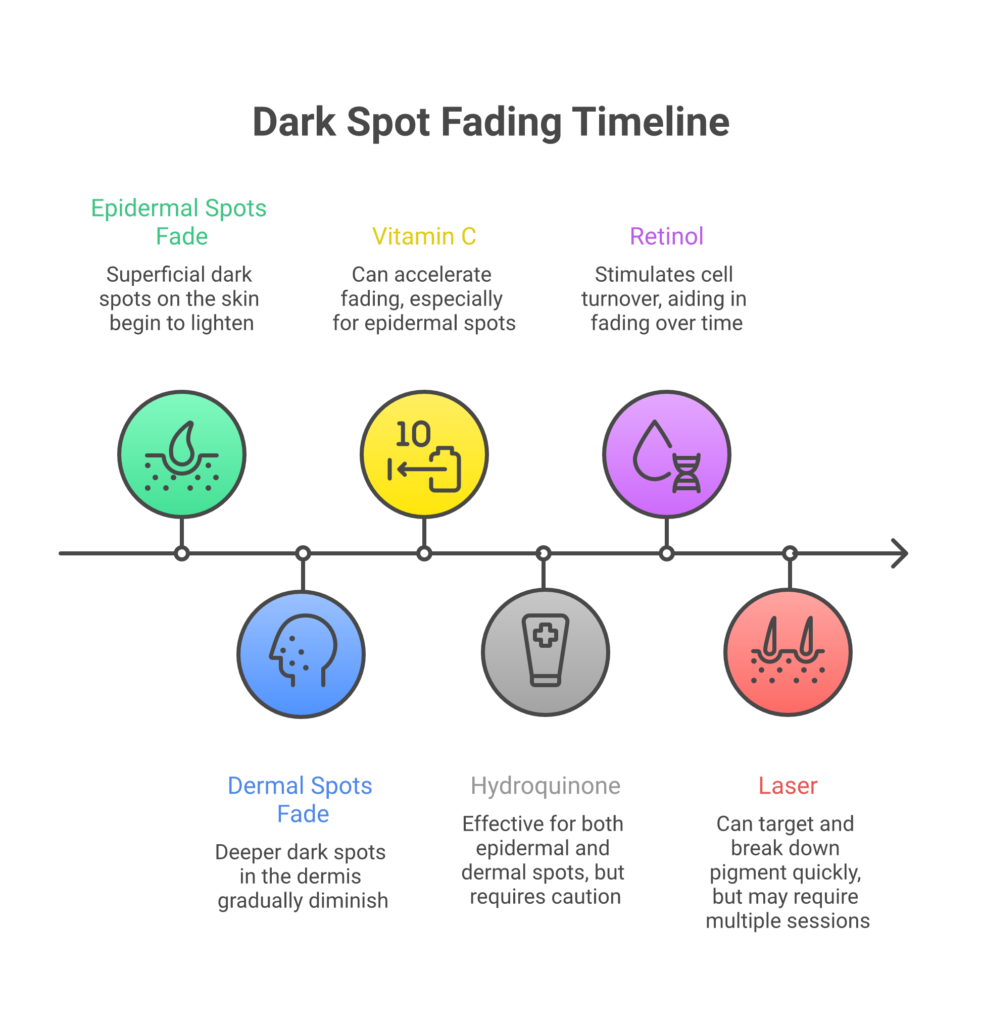
How Long Do Dark Spots Take to Fade? A Complete Timeline

Dr. Matthew Olesiak, MD, is the Chief Medical Director at SANESolution, a renowned wellness technology company dedicated to providing evidence-based solutions for optimal living. Dr. Olesiak earned his medical degree from the prestigious Jagiellonian University Medical College in Kraków, Poland, where he developed a strong foundation in medicine.
You slathered on a new serum three weeks ago, and that stubborn dark spot on your cheek hasn’t budged. Sound familiar? If you’ve ever Googled “how long do dark spots take to fade,” you already know the frustration of watching the same patch of uneven skin tone day after day, wondering if anything is working.
Here’s the honest answer: most dark spots take 3 to 12 months to fade with consistent topical treatments, and some can linger for 2 years or longer without intervention. That range is enormous, and where your spots fall on that timeline depends on a handful of specific factors I’ll break down below.
I’ve spent years tracking what actually moves the needle on skin pigmentation issues, and I can tell you right away: the fading process isn’t random. The cause of the spot, its depth in your skin structure, your skin tone, and whether you’re wearing broad spectrum sunscreen every single day predict about 80% of how long you’ll be waiting.
The Short Answer: A Dark Spot Fading Timeline
Before we go deep, here’s the quick reference. If you want the full picture, keep reading, but if you’re in a rush, this table covers the basics.
| Type of Dark Spot | Without Treatment | With Consistent Treatment |
|---|---|---|
| Post acne marks (PIH) | 6-18 months | 3-6 months |
| Sun spots / age spots | May never fully fade | 6-12 months |
| Melasma patches | Years (often recurring) | 6-24+ months |
| Light brown spots (mild) | 3-6 months | 4-8 weeks |
| Deep dermal pigment | 2+ years | 12-24 months |
That’s the snapshot. But if you want to actually fade dark spots on your face as fast as possible, you need to understand why the range is so wide.
What Are Dark Spots, Exactly?
Dark spots, technically called hyperpigmentation, happen when your skin cells produce excess melanin in a concentrated area. Melanin is the pigment that gives skin its color. When something triggers melanin-producing cells (melanocytes) into overdrive, generating extra melanin, the result is a flat, discolored patch of brown pigment darker than the surrounding skin. This skin condition affects people of all ages and skin types. The American Academy of Dermatology notes that spots a few shades darker than your natural skin tone typically fade within 6 to 12 months, while deeper pigmentation can persist for years.
Not all dark spots behave the same way. The three main types each affect the fading process differently:
Post-Inflammatory Hyperpigmentation (PIH)
This is the most common type, especially if you deal with active acne. Post inflammatory hyperpigmentation PIH shows up as dark spots after acne breakouts, bug bites, eczema flares, or any skin injury. The inflammation triggers excess melanin production, leaving a brownish or purplish mark after the healing process completes. PIH sits in the epidermis (the top layer) in most cases, which means it’s the fastest type to fade, usually 3 to 6 months with the right approach. Post acne marks are among the most treatable skin concerns in dermatology.
Sun Spots (Solar Lentigines)
Also called age spots or liver spots, these develop from years of chronic sun exposure. They’re most common on areas that get the most UV rays: face, hands, shoulders, chest. Unlike PIH, sun spots don’t go away on their own because the melanin damage is embedded more deeply in the skin structure. Without active treatment and strict sun protection, these can be permanent. If you want to treat sun damage effectively, you’ll need targeted topical treatments or professional cosmetic treatments.
Melasma
Melasma is the most stubborn form of deeper pigmentation. It’s driven by hormonal changes (pregnancy, birth control pills, hormone replacement therapy) and tends to appear as larger, symmetrical patches on the cheeks, forehead, and upper lip. What makes melasma frustrating is that it often extends into the deeper layers of skin (dermal melasma), and it recurs even after successful treatment, with flare ups triggered by sun exposure or hormonal shifts. If you’re dealing with dark spots during pregnancy, melasma is almost always the culprit.
How Long Do Dark Spots Take to Fade by Skin Tone?
This is something most articles completely gloss over, and it matters. A lot.
Your skin tone plays a major role in both how likely you are to develop dark spots and how long those dark spots take to clear. People with darker skin tones have more active melanocytes, which means the pigment response to inflammation or direct sun exposure tends to be stronger. That’s not a flaw; it’s just how melanin rich skin works. But it does mean that treating hyperpigmentation on darker skin requires more patience and a slightly different approach.
| Skin Tone | PIH Fading Time | Sun Spot Fading Time | Key Considerations |
|---|---|---|---|
| Fair / Light | 2-4 months | 4-8 months | Faster cell turnover; higher risk from UV rays |
| Medium / Olive | 3-6 months | 6-10 months | Moderate melanin response; consistent SPF crucial |
| Darker skin tones | 6-12 months | 8-14 months | Avoid aggressive treatments that cause further pigmentation |
| Very dark / Deeper skin tones | 6-18 months | 10-18 months | Use gentle actives; high-strength peels risky |
For darker skin types specifically, the biggest risk isn’t the dark spot itself; it’s making things worse with overly more aggressive treatments. High-concentration chemical peels, certain lasers, and harsh scrubbing can trigger more post inflammatory hyperpigmentation in deeper skin tones. That’s why gentler ingredients like niacinamide and azelaic acid are often better starting points than 20% glycolic acid.
7 Factors That Determine How Fast Dark Spots Fade
Two people can have what looks like the exact same dark spot and get wildly different results. Here’s why the fading process varies so much.
1. Depth of Skin Pigmentation (Epidermal vs. Dermal)
This is the single biggest predictor. Epidermal dark spots (in the top layer) fade faster because your skin cells naturally turn over every 28 to 40 days. Each cell turnover cycle pushes excess melanin closer to the skin’s surface, where it’s eventually shed as dead skin cells. Deeper pigmentation (dermal hyperpigmentation) takes dramatically longer because that melanin is trapped below the turnover zone. A quick way to check: stretch the skin, and if the spot becomes less visible, it’s likely epidermal. If it stays the same, it’s deeper.
2. Sun Exposure and UV Rays
If I could tattoo one rule on every person struggling with dark spots, it would be this: unprotected sun exposure will undo months of progress in a single afternoon. UV rays directly stimulate melanocytes to produce more melanin. Even 15 minutes of direct sunlight can darken a fading spot back to where it started. And It goes beyond UV; visible light (especially high-energy blue light) also triggers melanin production, particularly in darker skin. This is why tinted sunscreens with iron oxide provide the most complete sun protection against further pigmentation.
3. Your Skin Type and Tone
As I covered above, skin tones with more melanin tend to produce stronger pigment responses. But skin type matters too. Sensitive skin needs gentler actives, because irritation is inflammation, and inflammation triggers more dark spots. Oily skin types can generally tolerate stronger actives like retinoids and glycolic acid. Dry or sensitive darker skin types may do better starting with azelaic acid for overall skin health improvement.
4. The Cause of the Dark Spot
Dark spots from a one-time event (a pimple, a mosquito bite, a minor burn) fade more predictably because the trigger is gone. Melasma and sun spots are harder because the triggers (hormones and chronic sun exposure) are ongoing. If you still have active acne producing new breakouts, you’ll keep generating fresh post acne marks even as you lighten dark spots from older ones. Address the root cause alongside your brightening routine.
5. Age and Cell Turnover Rate
In your 20s, skin cells turn over roughly every 28 days. By your 50s, that cycle can stretch to 45-60 days. Slower turnover means dead skin cells hang around longer, and dark spots take more time to work their way out. This is partly why dark spots after 50 can feel so persistent. Stimulating collagen production through retinoids or microneedling can help speed up this process and improve overall skin tone and skin texture simultaneously.
6. Whether You’re Actually Treating Them
This sounds obvious, but I see it constantly: people expecting dark spots to vanish on their own without any targeted treatment. Mild hyperpigmentation from a single pimple? Sure, that might fade in 3 to 6 months without help. But sun spots, melasma, and recurring PIH almost always need active ingredients. Using topical treatments consistently with the right formulations can cut your fading timeline by 30-50%, leading to visibly brighter skin months sooner.
7. Consistency of Your Routine
Using a serum twice a week isn’t going to give you the same results as daily use. The research on most brightening ingredients shows that consistent daily application for a minimum of 8-12 weeks is needed before meaningful improvement appears. Inconsistent treatment is one of the top reasons people don’t achieve clearer skin from their routines.
How to Fade Dark Spots Faster: Best Ingredients and Topical Treatments
These are the ingredients with the strongest evidence for treating dark spots. If you want a broader look at dark spot treatment options for your face, I’ve covered that in depth elsewhere. Here’s the core lineup for targeting skin pigmentation.
Vitamin C (L-Ascorbic Acid)
A potent antioxidant that inhibits tyrosinase, the enzyme responsible for melanin production. At 10-20% concentrations, it can visibly brighten dark spots within 8-12 weeks of daily use. It also provides photoprotection, helping prevent new dark spots from forming. Look for formulations stabilized at a low pH (below 3.5). Pairs exceptionally well with sunscreen for overall skin health.
Retinoids (Retinol, Tretinoin, Adapalene)
Retinoids accelerate skin cell turnover, pushing pigmented dead skin cells out faster while also boosting collagen production. Over-the-counter retinol typically takes 12-16 weeks to show visible improvement. Prescription-strength tretinoin works faster, often within 8-12 weeks. The catch: retinoids can cause irritation and sun sensitivity, especially in the first 4-6 weeks. Start slow (2-3 times per week) and always pair with strong sun protection.
Niacinamide (Vitamin B3)
Niacinamide works differently: instead of blocking melanin production, it reduces the transfer of melanin from melanocytes to surrounding skin cells. At 5% concentration, it improves uneven skin tone within 8-12 weeks. The best part? It’s gentle enough for virtually every skin type, strengthens the skin barrier, reduces inflammation, and even helps with enlarged pores and oil control.
Azelaic Acid
One of the most underrated ingredients for treating hyperpigmentation. It inhibits tyrosinase (like vitamin C), has anti-inflammatory properties, and normalizes keratinization. At 15-20% concentrations, it’s particularly effective for post inflammatory hyperpigmentation and melasma. It’s also safe during pregnancy. Results typically appear within 12-16 weeks.
Alpha Hydroxy Acids (Glycolic Acid, Lactic Acid)
AHAs dissolve bonds between dead skin cells on the skin’s surface, accelerating the shedding process and revealing fresher skin underneath. Glycolic acid is the smallest AHA molecule, penetrating deepest and working fastest. At daily-use concentrations (5-10%), expect to start seeing lighter dark spots within 4 to 12 weeks. Higher concentrations (20-70%) are used in professional chemical peels.
Alpha Arbutin
Gentler than hydroquinone but with a similar mechanism, alpha arbutin inhibits excess melanin production without irritation risk. Results appear within 8-16 weeks. It works well layered with niacinamide for a multi-pathway approach to achieve brighter skin.
Hydroquinone
The go-to for stubborn dark spots for decades. At 2% (over-the-counter) or 4% (prescription), it directly suppresses melanin production. Kojic acid offers a gentler alternative with a similar mechanism. Often shows results within 4-8 weeks. But it shouldn’t be used continuously for more than 5-6 months, as prolonged use can paradoxically cause darkening (ochronosis). According to the National Library of Medicine’s StatPearls resource, physicians recommend stopping treatment after 3-6 months for a few months before restarting to reduce side effects.
Broad Spectrum Sunscreen (SPF 30+)
I’m including sunscreen as an “ingredient” because it’s the single most important product in any dark spot routine. Without wearing sunscreen daily and maintaining consistent sun protection, every other ingredient is fighting a losing battle. Use a broad spectrum SPF 30 or higher every morning (yes, even cloudy days). For dark spots specifically, tinted formulas with iron oxide block visible light too, which is essential for melanin-rich skin and melasma. Reapply every 2 hours outdoors.
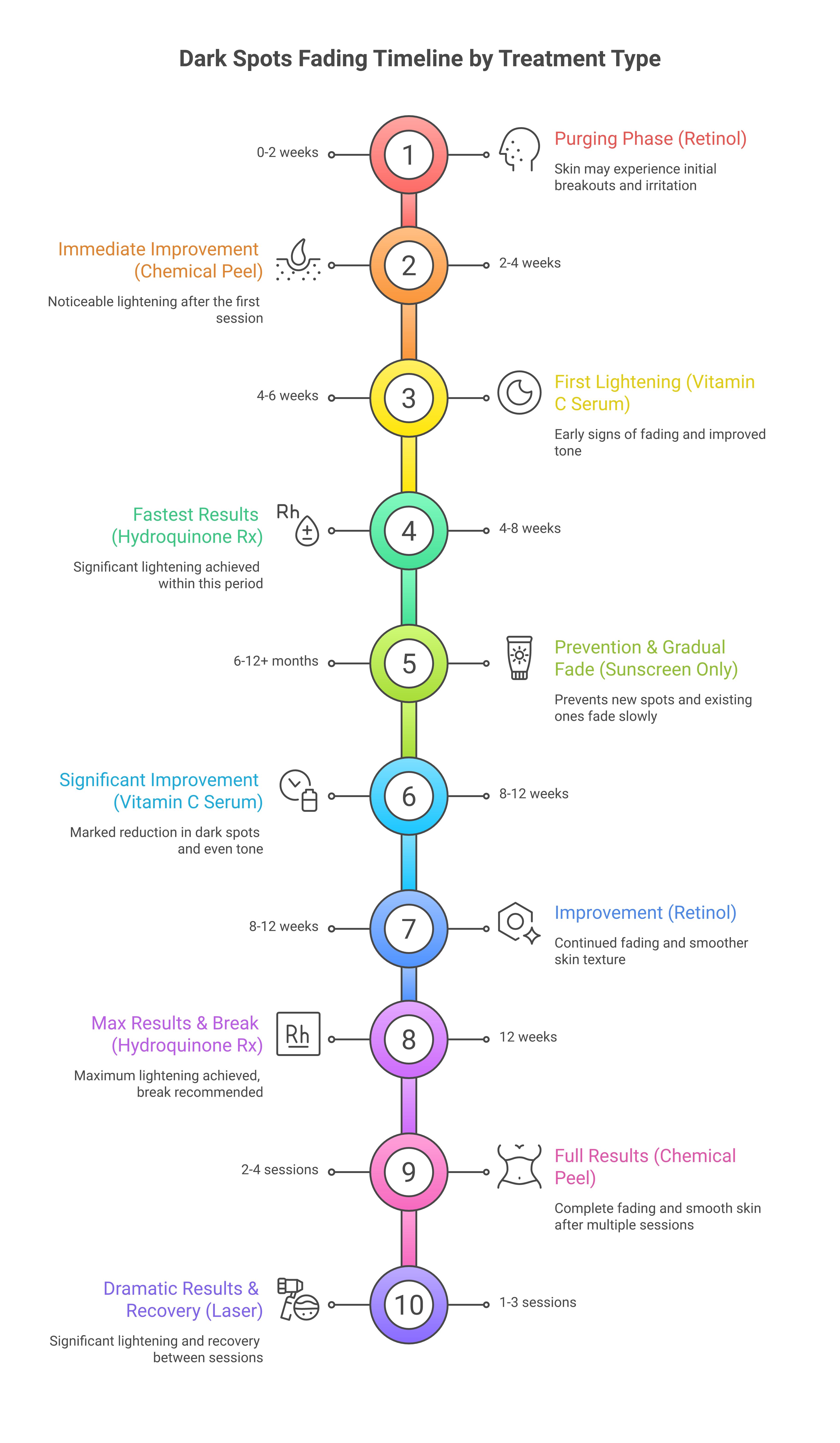
Fading Timeline by Treatment Type
How long does it take for dark spots to actually respond to each approach? Here’s what realistic expectations look like for the fading process:
| Treatment | Time to First Results | Full Fading Timeline | Best For |
|---|---|---|---|
| Vitamin C serum (daily) | 4-8 weeks | 3-6 months | All skin types; prevention + fading |
| Retinol (OTC) | 8-12 weeks | 4-8 months | Non-sensitive skin; aging + dark spots |
| Niacinamide (5%+) | 8-12 weeks | 3-6 months | Sensitive skin; gentle approach |
| Glycolic acid (daily) | 4-8 weeks | 3-6 months | Surface-level spots; skin texture improvement |
| Azelaic acid (15%+) | 8-16 weeks | 4-8 months | Acne-prone + sensitive; melasma |
| Hydroquinone (2-4%) | 4-8 weeks | 3-5 months (cycle off) | Stubborn spots; fastest topical option |
| Chemical peels (professional) | After 1st peel | 3-6 peels over 3-6 months | Moderate to severe hyperpigmentation |
| Laser therapy / IPL treatment | After 1st session | 2-6 sessions over 2-6 months | Sun spots; stubborn age spots |
| Microneedling | After 2nd session | 3-6 sessions over 4-9 months | Acne scars + pigment; collagen boost |
Almost nothing works overnight. The fastest topical results come from hydroquinone and glycolic acid, and even those take a few weeks to a month. This is normal. Your skin cells need time to turn over, and melanin already deposited has to work its way to the surface before it can be shed as dead skin cells.
Professional Cosmetic Treatments for Stubborn Dark Spots
When at-home topical treatments aren’t cutting it after 3-6 months, or when you’re dealing with deep dermal pigment, professional cosmetic treatments and other cosmetic treatments can accelerate results. Several treatments are usually needed for significant improvement.
Chemical Peels and the Healing Process
Professional-grade chemical peels apply concentrated acid solutions (glycolic, salicylic, lactic, or TCA) to remove dead skin cells and damaged outer layers. Medium-depth peels break up pigment clusters that topicals can’t reach. A series of 3-6 peels, spaced 4-6 weeks apart, is typical. The healing process after each session takes about 5-7 days, during which skin responds with accelerated renewal. Cost runs $150-$400 per session.
Laser Therapy, Laser Resurfacing, and IPL Treatment
Intense pulsed light and other laser treatments for dark spots use focused light energy to break apart melanin deposits. IPL treatment is particularly effective for sun spots and age spots on lighter skin tones. For darker skin, specific wavelengths (like Nd:YAG at 1064nm) are safer because they bypass epidermal melanin and target the deeper layers. Laser resurfacing is a more aggressive option that can treat sun damage and improve skin texture at the same time. Most people need 2-6 sessions spaced 3-4 weeks apart. Results can be dramatic, but laser therapy on the wrong skin type can cause further pigmentation.
Microneedling for Acne Scars and Pigmentation
Microneedling creates thousands of micro-injuries using fine needles, triggering a natural wound-healing response as the skin heals that helps stimulate collagen production and speed up cell turnover. On its own, it helps with mild hyperpigmentation. Combined with brightening serums (tranexamic acid applied post-treatment), it significantly accelerates the fading process. Expect 3-6 sessions spaced 4-6 weeks apart. A dermatologist can create a personalized treatment plan based on how your skin responds to the first session.
The #1 Rule: Sun Protection Is Non-Negotiable
I’ve mentioned this throughout, but it deserves its own section because this is where most people’s dark spot routines fail. You can use every brightening serum on the planet, but without daily sun protection, you’re pouring water into a leaky bucket.
- SPF 30 or higher, broad spectrum sunscreen, applied every morning
- Reapply every 2 hours when outdoors (or after sweating/swimming)
- Tinted sunscreen with iron oxide for visible light protection, particularly important for darker skin tones and melasma
- UPF clothing and hats for extended outdoor time
- Avoid peak sun hours (10 AM to 2 PM) when UV rays are strongest
Sunscreen makes every other treatment work. Without it, your topical treatments can’t outpace the melanin production that UV exposure triggers. Sun protection isn’t just about preventing new dark spots; it’s actively allowing existing spots to fade.
When Dark Spots Aren’t Fading: What’s Going Wrong?
If you’ve been treating dark spots for 3+ months and seeing zero improvement, something needs to change. Here are the most common reasons the fading process stalls:
You’re Skipping Broad Spectrum Sunscreen (or Under-Applying)
Most people use about 25% of the sunscreen they actually need. For your face alone, you need roughly a nickel-sized dollop. Anything less, and you’re getting a fraction of the labeled SPF. If you’re not reapplying during the day, you’re basically unprotected by afternoon.
The Deeper Pigmentation Is Below Topical Reach
Topical treatments primarily target epidermal pigment. If your dark spots are dermal (deeper layers), over-the-counter products will improve them slowly at best. A dermatologist can do a Wood’s lamp exam to determine pigment depth and build a personalized treatment plan using more aggressive treatments if needed.
You’re Causing More Inflammation and Further Pigmentation
Picking at spots, layering too many harsh actives, or over-exfoliating creates a cycle of inflammation and new post inflammatory hyperpigmentation. If your dark spots keep appearing, the underlying trigger (active acne, irritation, hormonal fluctuation) needs to be managed alongside your brightening routine to support overall skin health.
Your Products Aren’t the Right Strength
A serum at 5% concentration won’t deliver the same results as one at 15%. Check concentrations and pH stability. Make sure you’re applying enough product; a tiny dab once a week barely impacts skin pigmentation.
You Need to Combine Approaches
The strongest results come from combining ingredients that work through different pathways. Example: an antioxidant and tyrosinase inhibitor in the morning with sunscreen, and a cell turnover accelerator at night with niacinamide (melanin transfer blocker). Multi-pathway regimens consistently outperform single-ingredient approaches in both speed and final results for achieving clearer skin and a more even overall skin tone.
A Realistic Dark Spot Fading Routine for Healthy Skin
Here’s what an effective daily routine looks like when you’re serious about fading. This isn’t about buying 12 products; it’s about using the right few, consistently, for healthy skin that’s actively improving.
Morning
- Gentle cleanser (nothing that strips or tightens)
- Antioxidant serum (10-20% L-ascorbic acid for skin health)
- Moisturizer (to maintain the skin barrier)
- Tinted broad spectrum sunscreen SPF 30+ with iron oxide (generous application)
Evening
- Double cleanse (oil-based first, then gentle water-based)
- Active treatment (retinoid OR azelaic acid OR glycolic acid, based on your skin type)
- Niacinamide serum (5% or higher)
- Barrier-supporting moisturizer
Weekly
- One gentle exfoliation session (AHA at 5-10%) if not using daily glycolic acid
- Progress photos every 2-4 weeks (same lighting, same angle) because your memory is unreliable for tracking slow changes
For a full step-by-step regimen, check out our guide on how to remove dark spots from your face.
When to See a Dermatologist About Dark Spots
Not every dark spot needs professional attention. But certain situations call for expert evaluation:
- No improvement after 6 months of consistent at-home topical treatments
- Dark spots getting darker despite sun protection and active ingredients
- Spots that have changed shape, size, or texture (asymmetry, irregular borders, raised areas could signal something other than hyperpigmentation)
- Melasma that hasn’t responded to over-the-counter treatments
- Dark spots on darker skin where you want to avoid worsening things with the wrong cosmetic treatments
- Multiple skin concerns including acne scars, enlarged pores, and uneven skin tone that need a coordinated personalized treatment plan
A dermatologist can determine pigment depth, rule out anything serious, and prescribe stronger options like tretinoin or combination formulations not available over the counter. The Mayo Clinic recommends evaluation for any spot that is increasing in size, has an irregular border, has an unusual combination of colors, or is bleeding.
Can Dark Spots Fade Completely? Setting Realistic Expectations
This is the question everyone wants answered, and the honest answer depends on the type.
Post inflammatory hyperpigmentation from acne, cuts, or burns? Yes, these almost always lighten dark spots completely with time and treatment. Mild cases from a single breakout can clear entirely within 3-6 months. Even darker post acne marks in melanin-rich skin eventually resolve, though the very deepest spots may leave a faint shadow for a year or more.
Sun spots and age spots can be significantly lightened and sometimes fully removed with professional treatments like laser therapy or intense pulsed light. At-home products lighten them considerably but may not eliminate spots that have been developing for decades from chronic sun exposure.
Melasma is the tricky one. It can be managed and reduced, but “cured” isn’t really the right word. Hormonal triggers are difficult to eliminate, and melasma recurs frequently. The goal is typically even toned skin maintained through an ongoing routine rather than a one-time fix.
For most types of dark spots, significant fading is absolutely achievable. Complete elimination depends on depth, cause, and your willingness to stick with a consistent approach including sun protection for the long haul.
Frequently Asked Questions
Can dark spots fade on their own without any treatment?
Some can, some can’t. Light brown spots from a minor pimple or bug bite often resolve on their own within 3-6 months as skin cells turn over naturally. However, sun spots, melasma, and deeper PIH rarely disappear without active topical treatments. Even for self-resolving spots, sunscreen and an antioxidant serum speed the fading process along significantly.
What is the fastest way to lighten dark spots?
The fastest topical option is hydroquinone (2-4%), which can show visible results in 4-8 weeks. For absolute speed, professional chemical peels or IPL treatment produce noticeable improvement after a single session. But speed comes with caveats: more aggressive treatments carry higher risk of irritation and rebound skin pigmentation, especially for darker skin tones.
How long does it take retinol to fade dark spots?
Over-the-counter retinol typically takes 12-16 weeks of consistent nightly use to produce visible fading. Prescription retinoids like tretinoin work faster, often within 8-12 weeks. The key is patience through the initial adjustment period of 4-6 weeks.
Why are my dark spots getting darker instead of fading?
Three common reasons: unprotected sun exposure (the #1 cause), using products that are too harsh and causing irritation-driven excess melanin production, or an underlying condition like melasma being triggered by hormones. If dark spots are worsening, stop all actives for 2 weeks, focus on gentle cleansing and sunscreen, and see a dermatologist.
Do dark spots from acne scars ever go away completely?
Yes. In the vast majority of cases, post acne marks fade completely. It can take 3 months to over a year depending on depth and skin tone, but they’re among the most treatable forms of hyperpigmentation. Note: actual depressed or raised acne scars are different from dark spots and require different treatments like microneedling or laser resurfacing.
Does vitamin C really work for dark spots?
Yes, with strong evidence backing it. At 10-20% concentration, it inhibits melanin production, provides antioxidant protection, and works synergistically with sunscreen to fade spots. Consistent daily use for 12 weeks showed significant lightening of hyperpigmentation across multiple skin tones in published research. It’s not the fastest option but has an excellent safety profile and additional benefits for overall skin health that other brightening ingredients lack.
What’s the best treatment for dark spots on the face?
There’s no single “best.” It depends on the type of dark spot, your skin type, and your budget. For most people, a good dark spot corrector (containing niacinamide, or alpha arbutin), a retinoid at night, and daily broad spectrum sunscreen is the highest-impact, lowest-risk approach. For stubborn spots that don’t respond within 6 months, professional chemical peels, laser treatments, or multiple treatments may be needed to achieve the brighter skin and clearer skin you’re after.
The Bottom Line on Dark Spot Fading Timelines
How long do dark spots take to fade? The real answer: 3 to 12 months for most people doing it right, with melasma and deep dermal pigment taking longer. The most important variables are consistent sun protection (broad spectrum sunscreen, reapplied), evidence-based topical treatments, and giving your routine enough time before switching things up.
Track your progress with photos every 2-4 weeks. If you don’t see any change after 12 weeks with a solid routine, escalate: add stronger actives, combine ingredients for a multi-pathway approach, or consult a dermatologist about professional cosmetic treatments. A personalized treatment plan that accounts for your skin type, the depth of pigmentation, and your specific skin concerns will always outperform a generic approach.
The spots didn’t appear overnight, and they won’t disappear overnight either. But with the right approach and consistency, you will see the fading process through to clearer, more even-toned skin.

