
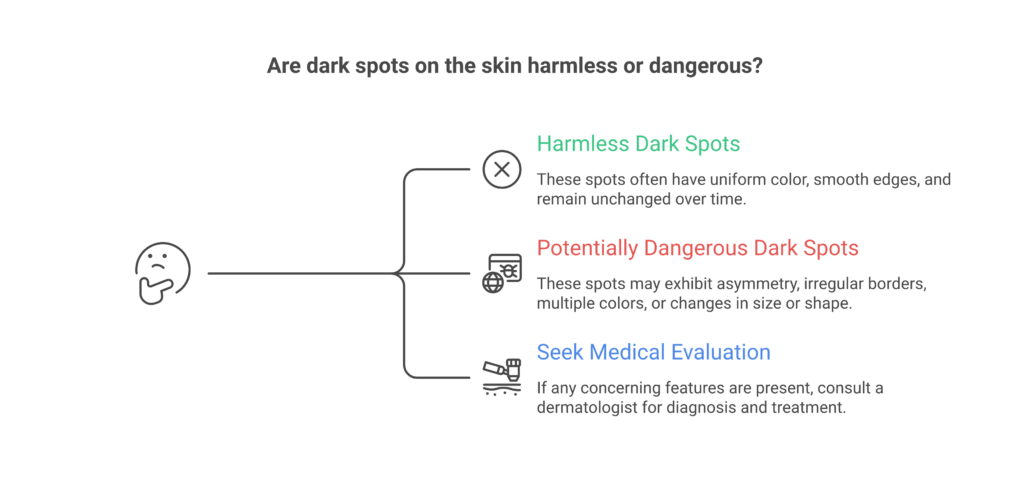
Are Dark Spots Dangerous? How to Tell the Difference and When to Worry

Dr. Matthew Olesiak, MD, is the Chief Medical Director at SANESolution, a renowned wellness technology company dedicated to providing evidence-based solutions for optimal living. Dr. Olesiak earned his medical degree from the prestigious Jagiellonian University Medical College in Kraków, Poland, where he developed a strong foundation in medicine.
The short answer: most dark spots on skin are completely harmless. But a small percentage can signal something serious — including skin cancer. Here’s how to tell the difference, what warning signs to watch for, and when you should get a spot checked by a professional.
Disclaimer: This article is for informational purposes only and does not constitute medical advice. Always consult a qualified healthcare provider for diagnosis and treatment of any skin conditions.
I get it — you’ve noticed a new brown spot on your face, or maybe an old one seems darker than you remember. Your first instinct is to Google “are dark spots dangerous,” and now you’re spiraling through worst-case scenarios. Take a breath. You’re doing the right thing by researching, and I’m going to walk you through exactly what you need to know.
The reality? Roughly 90% of adults over 50 have at least a few dark spots on skin. The overwhelming majority are benign — meaning they’re not cancerous and won’t become cancerous. But ignoring the other 10% of cases would be irresponsible. Some dark spots, brown spots, and unusual marks on the skin can be early indicators of melanoma or other forms of skin cancer. And with melanoma, early detection is everything: catching it early yields a 99% five-year survival rate, while late-stage detection drops that number to 35%.
So let’s break this down — no panic, no medical jargon you can’t follow. Just a practical guide to understanding what’s on your skin.

What Causes Dark Spots in the First Place?
Before we talk danger, we need to talk mechanics. Dark spots form when skin cells produce excess melanin — the pigment that gives your skin its color. This overproduction creates concentrated patches that appear darker than the surrounding skin. Several factors trigger this process:
- Sun exposure — the number one cause. Years of UV radiation damage the outer layer of skin and trigger melanin overproduction in specific areas of the skin. This is cumulative, which is why brown spots tend to show up after decades of sun damage.
- Hormonal shifts — pregnancy, birth control, and menopause can all trigger dark spots, particularly on the face.
- Post-inflammatory responses — acne, eczema, cuts, and burns can leave behind dark marks after the skin heals.
- Aging — as we get older, melanin distribution becomes less uniform, and sun-exposed areas accumulate visible damage.
- Genetics and skin tone — people with deeper skin tones produce more melanin and may be more prone to hyperpigmentation, though all skin types can develop dark spots.
Understanding what caused your spots is actually the first step in figuring out whether they’re harmless or something that needs attention.
Common Types of Dark Spots That Are NOT Dangerous
Let’s start with the reassuring news. These are the brown spots and dark spots that dermatologists see every single day — and they’re nothing to lose sleep over.
Age Spots (Solar Lentigines)
Also called sun spots or liver spots, these flat, oval patches range from light tan to dark brown. They show up on sun exposed areas like the face, hands, shoulders, and forearms. If you’re over 40 and have spent any meaningful time outdoors, you probably have a few. They’re caused by years of cumulative sun exposure and excessive sun exposure accelerating melanin deposits in the epidermis.
Age spots are almost always benign. They don’t itch, they don’t bleed, and they stay the same size year after year. That said, any age spot that starts changing warrants a closer look.
Melasma
Melasma produces larger, blotchy dark brown or grayish-brown patches — usually on the cheeks, forehead, nose, and upper lip. It’s driven by hormonal changes combined with sun exposure, which is why it’s sometimes called “the mask of pregnancy.” Melasma isn’t dangerous in any medical sense, but it can be stubborn to treat. The hormones that drive skin darkening make melasma particularly frustrating because it tends to recur.
Post-Inflammatory Hyperpigmentation (PIH)
Ever had a pimple heal and leave behind a dark mark? That’s PIH. It happens when inflammation triggers melanocytes (your pigment-producing skin cells) to go into overdrive. Acne, burns, cuts, eczema, and even aggressive skincare treatments can cause it. PIH is temporary — though “temporary” can mean anywhere from 3 months to 2 years depending on your skin tone and sun protection habits.
Freckles and Seborrheic Keratoses
Freckles are genetic and harmless — they’re tiny clusters of melanin that darken with sun exposure and fade in winter. Seborrheic keratoses are waxy, raised, brown or black growths that look like they’ve been stuck onto the skin. They’re extremely common after age 50, can look alarming, but are completely benign. I’ve seen people panic over a seborrheic keratosis that looked “suspicious,” only to find out it was as dangerous as a freckle.
When Dark Spots ARE Dangerous: Warning Signs You Can’t Ignore
Here’s where we shift gears. While most brown spots fall into the harmless categories above, certain dark spots on skin can be an early sign of skin cancer — specifically melanoma, the most aggressive type. Melanoma accounts for about 1% of all skin cancers but causes the vast majority of skin cancer deaths. The critical thing to understand is that 70-80% of melanomas develop on seemingly normal skin, not from existing moles.
That statistic alone should tell you why regular skin checks matter. You can’t just monitor your existing spots and assume you’re covered — you need to watch for entirely new ones too.
Melanoma
Melanoma forms when the DNA in melanocytes (pigment cells) becomes damaged, usually by UV radiation from sun exposure or tanning beds. These damaged skin cells begin multiplying uncontrollably, forming malignant tumors. Melanoma can appear anywhere on the body, but it’s most common on sun-exposed areas of the skin in fair-skinned individuals. In people with darker skin tones, melanoma more frequently develops on palms, soles, and under fingernails.
What makes melanoma so dangerous is its ability to spread. If caught early while still in the outer layer of skin (the epidermis), treatment is straightforward and survival rates are excellent. But once it penetrates deeper and reaches the lymph nodes or bloodstream, outcomes worsen dramatically.
Basal Cell Carcinoma
Basal cell carcinoma is the most common form of skin cancer. It often appears as a pearly or waxy bump, a flat flesh-colored lesion, or a brown scar-like area. It rarely spreads to other parts of the body, but it can cause significant local tissue damage if left untreated. Sun damage is the primary driver.
Squamous Cell Carcinoma
Squamous cell carcinoma often shows up as a firm, red nodule or a flat lesion with a scaly, crusted surface. Like basal cell carcinoma, it’s driven by cumulative sun exposure and too much sun exposure over years. It’s more aggressive than basal cell and can spread if not treated promptly.
The ABCDEs of Melanoma: Your 5-Point Self-Check Guide
This is the most practical tool you’ll find for evaluating a suspicious spot at home. The ABCDEs of melanoma were developed by dermatologists as a simple framework to help people spot skin cancer early. Print this out, bookmark this page, whatever — just commit it to memory.
A — Asymmetry
Draw an imaginary line through the middle of the spot. Do both halves look roughly the same? Benign brown spots and moles are typically symmetrical — round or oval, with matching halves. If one half looks noticeably different from the other in shape, size, or color, that’s a red flag. Melanoma lesions tend to grow unevenly, creating asymmetrical shapes.
B — Border Irregularity
Look at the edges. Normal moles and age spots have smooth, well-defined borders — you can clearly see where the spot ends and the surrounding skin begins. Dangerous spots often have borders that are ragged, notched, scalloped, or blurred. If the edges look like they’re bleeding out into the surrounding skin, that’s concerning.
C — Color Variation
Harmless dark spots are typically one uniform color — a consistent shade of brown, tan, or dark brown. Melanoma, on the other hand, often contains multiple colors within the same lesion. You might see shades of brown mixed with black, red, white, pink, or even blue. Any spot with more than two distinct colors deserves professional evaluation.
D — Diameter
The general guideline: anything larger than 6 millimeters (roughly the size of a pencil eraser) should be checked. However — and this is important — melanomas can be smaller than 6mm, especially in the early stages. Size alone isn’t definitive, but a large or growing dark spot warrants attention.
E — Evolving
This is arguably the single most important letter. An evolving mole — one that’s changing in size, shape, color, or elevation — is the strongest warning sign. Benign spots stay stable. They don’t suddenly get bigger, change color, start itching, or begin bleeding. If any dark spot on your body is noticeably different than it was a month or two ago, don’t wait. Get it checked.
The “Ugly Duckling” Sign
Beyond the ABCDEs, dermatologists also use what’s called the “ugly duckling” approach. Most of your moles should look generally similar to each other. If one spot looks dramatically different from everything else on your body — the ugly duckling among a flock — it deserves extra scrutiny. This method catches some melanomas that might not meet all ABCDE criteria individually.
Visual Comparison: Harmless Dark Spots vs. Suspicious Spots
Sometimes a side-by-side comparison makes the difference clearer than any description. Here’s what to look for when examining brown spots and dark spots on your own skin:
| Feature | Likely Harmless | Potentially Dangerous |
|---|---|---|
| Shape | Round or oval, symmetrical | Asymmetrical, irregular shape |
| Borders | Smooth, well-defined edges | Ragged, blurred, or notched edges |
| Color | One uniform shade of brown or tan | Multiple colors (brown, black, red, white, blue) |
| Size | Typically smaller than 6mm | Larger than 6mm or rapidly growing |
| Surface | Flat or slightly raised, smooth | Ulcerated, bleeding, crusty |
| Stability | Unchanged for months or years | Changing in size, shape, or color |
| Sensation | Painless, no itching | Itching, tenderness, or pain |
Use this table as a quick reference, but remember — it’s a starting point, not a diagnosis. Some melanomas don’t follow the “rules” at all. Amelanotic melanomas, for instance, have little to no pigment and can appear pink, red, or skin-colored. These are tricky to spot skin cancer variants that often get missed.
What Causes Dangerous Spots to Develop?
Not all dark spots carry the same risk. Understanding what drives malignant skin conditions helps you assess your own risk level.
UV Radiation and Sun Damage
UV radiation from the sun (and from tanning beds) is the single biggest risk factor for melanoma and other skin cancers. UV rays directly damage the DNA inside skin cells. Most of the time, your body repairs this damage. But over years of repeated sun exposure and sun damage, some repairs fail — and that’s when uncontrolled cell growth can begin.
People who experienced severe, blistering sunburns before age 18 face a significantly elevated risk. And tanning beds are particularly dangerous — research from the American Academy of Dermatology indicates that even one tanning bed session before age 35 increases melanoma risk by 75%.
Genetics and Family History
About 10% of people diagnosed with melanoma have a family history of the disease. Certain genetic mutations (particularly in the CDKN2A gene) substantially increase susceptibility. If a first-degree relative has had melanoma, your own risk roughly doubles.
Fair Skin and Immune Factors
People with fair skin, light hair, and light eyes produce less melanin, which means less natural protection from UV radiation. That said, skin cancer can affect anyone regardless of skin tone. In fact, melanoma in people with darker skin tones is often diagnosed later because it occurs in less obvious areas of the skin — palms, soles, and under nails — where it’s easy to overlook.
Immunosuppression from organ transplants, certain medications, or conditions like HIV also increases risk for various skin conditions including skin cancer.
When You MUST See a Doctor About a Dark Spot
Here’s my rule of thumb: if you’re worried enough to search for information about whether a spot is dangerous, you should probably just schedule a skin examination. It takes 15 minutes and provides peace of mind that no article on the internet can match.
That said, these specific situations warrant a prompt appointment — don’t put them off:
- Any spot matching one or more ABCDE criteria — asymmetry, irregular borders, multiple colors, large diameter, or evolving characteristics
- A brand-new dark spot appearing after age 30 — while new benign spots can still appear, new moles after 30 are less common and should be evaluated
- A spot that bleeds, oozes, or crusts over — healthy dark spots don’t do this
- A sore that won’t heal within 3 weeks — persistent non-healing sores are a classic skin cancer warning sign
- Itching, tingling, or pain in a dark spot — benign hyperpigmentation doesn’t typically cause sensation
- A spot that looks different from everything else on your body — the ugly duckling principle
- Personal or family history of skin cancer — this puts you in a higher-risk category requiring more frequent monitoring
- History of excessive sun exposure or tanning bed use — especially if you had severe sunburns in childhood or adolescence
Don’t let embarrassment, cost concerns, or the assumption that “it’s probably nothing” keep you from a skin examination. Catching skin cancer early literally saves lives.
How Doctors Evaluate Suspicious Dark Spots
Wondering what actually happens when you go in for a skin check? Here’s the process — it’s quicker and less intimidating than most people expect.
Dermoscopy (Dermatoscope Examination)
The dermatologist uses a specialized magnifying tool called a dermatoscope, which provides a 10x view of the spot’s structure beneath the surface. This reveals patterns, colors, and structures invisible to the naked eye. Dermoscopy alone can rule out many suspicious spots without any cutting.
Full-Body Skin Exam
During a comprehensive skin examination, the doctor checks your entire body — including your scalp, between your toes, under your nails, and other areas of the skin you might never think to check yourself. This is particularly important because melanoma doesn’t always show up in obvious, sun-exposed locations.
Biopsy
If a spot looks suspicious under the dermatoscope, the next step is a biopsy. The doctor removes a small sample of tissue (or the entire lesion) and sends it to a lab where a pathologist examines it under a microscope. This is the only definitive way to determine whether a dark spot is benign or malignant. The procedure is quick, done under local anesthesia, and the results typically come back within 1-2 weeks.
Treating Brown Spots: From Harmless Discoloration to Concerning Lesions
If your dark spots turn out to be harmless hyperpigmentation — which, statistically, they almost certainly are — you’ve got several options to treat brown spots and reduce their appearance.
Topical Treatments
Over-the-counter and prescription lightening creams containing ingredients like alpha arbutin, niacinamide, vitamin C, and retinoids are the first line of defense for most people. Prescription lightening creams with higher concentrations of active ingredients (like hydroquinone) work faster but require medical supervision. These topical treatments work by inhibiting melanin production or accelerating cell turnover in the outer layer of the epidermis.
Professional Procedures
For stubborn brown spots that don’t respond to creams, several professional options exist:
- Chemical peels — acids remove the outer layer of damaged skin, revealing fresher skin beneath. Chemical peels range from superficial (glycolic acid) to deep (TCA peels), with deeper peels offering more dramatic results but longer recovery times.
- Laser therapy — targeted light energy breaks up melanin deposits. Q-switched lasers and fractional lasers are common choices for treating age spots and sun damage.
- Intense pulsed light (IPL) — similar to laser therapy but uses broad-spectrum light. Intense pulsed light is particularly effective for widespread sun spots across large areas of the skin.
- Microdermabrasion — physically removes the outermost layer of skin cells using fine crystals or a diamond-tipped wand.
Sun Protection: The Non-Negotiable Foundation
No treatment for brown spots works long-term without consistent sun protection. Period. UV radiation will simply re-trigger melanin production, and you’ll be right back where you started. Daily broad-spectrum SPF 30+ sunscreen, protective clothing, and avoiding peak UV hours (10 AM to 4 PM) are essential. Sun protection isn’t just about preventing new dark spots — it’s about preventing the kind of chronic sun damage that increases skin cancer risk.
How to Do a Monthly Skin Self-Check
You don’t need special training to catch something suspicious early. A systematic monthly self-exam takes about 10 minutes and could genuinely save your life. Here’s how:
- Get good lighting. Stand in front of a full-length mirror in a bright room. Use a hand mirror for hard-to-see areas.
- Start at your head. Check your scalp by parting your hair systematically. Use a comb and a blow dryer on cool setting to expose different sections.
- Examine your face closely. Pay special attention to your nose, lips, and ears — areas that get significant sun exposure and where dark spots commonly appear.
- Check your hands. Look at your palms, the backs of your hands, between your fingers, and under your nails.
- Work down your arms, torso, and legs. Don’t skip your underarms, chest, sides, and back (use the hand mirror).
- Examine your feet. Check the soles, between each toe, and under your toenails.
- Photograph anything that concerns you. Tracking spots with photos makes it much easier to notice changes over time.
The goal isn’t to diagnose yourself — it’s to notice changes. If something looks new, different, or concerning, schedule a professional skin examination.
Risk Factors: Are You More Likely to Develop Dangerous Dark Spots?
Some people face higher risk than others. Here’s a quick assessment of the major factors:
| Risk Factor | Risk Level | What It Means |
|---|---|---|
| Fair skin, light eyes, light hair | Higher | Less melanin = less UV protection |
| Family history of melanoma | Higher | 2x risk with first-degree relative |
| 50+ moles on body | Higher | More moles = more potential mutation sites |
| History of blistering sunburns | Higher | Especially burns before age 18 |
| Tanning bed use | Higher | 75% increased melanoma risk (before age 35) |
| Immunosuppression | Higher | Weakened immune response to abnormal cells |
| Darker skin tone | Lower overall, but… | Higher risk of late diagnosis; check palms, soles, nails |
If you check two or more boxes in the “higher risk” category, annual professional skin examinations should be a standard part of your healthcare routine. Don’t wait for something to look “wrong.”
The Bottom Line: What to Actually Do Right Now
You came here asking whether your dark spots are dangerous. Here’s the honest answer: they probably aren’t. The vast majority of dark spots, brown spots, age spots, sun spots, and liver spots are harmless hyperpigmentation caused by sun exposure, aging, hormones, or past skin conditions. They might be cosmetically annoying, but they’re not going to hurt you.
But “probably” isn’t good enough for your health. If any spot on your body matches the ABCDE criteria, if anything has changed recently, or if you just have a gut feeling that something looks off — schedule a skin check. It’s fast, it’s non-invasive, and it’s the only way to know for sure.
In the meantime, start addressing the harmless dark spots that bother you with proven topical treatments and consistent sun protection. Protect your skin from further sun damage by wearing SPF daily, avoiding tanning beds entirely, and making monthly self-checks a habit.
Your skin tells a story. Most of the time, that story is just sun exposure and aging. Occasionally, it’s a warning. Learning to read the difference is one of the simplest, most impactful things you can do for your long-term health.
Frequently Asked Questions
Do dark spots automatically mean I have skin cancer?
No — not even close. The vast majority of dark spots are benign forms of hyperpigmentation like age spots, melasma, or post-inflammatory hyperpigmentation. These skin conditions are caused by excess melanin production from sun exposure, hormonal changes, or past skin injuries. Only a very small percentage of dark spots turn out to be malignant. However, any new or changing spot should be evaluated by a dermatologist to rule out skin cancer.
What do cancerous dark spots look like?
Cancerous dark spots — particularly melanoma — tend to be asymmetrical, have irregular or blurred borders, contain multiple colors (dark brown mixed with black, red, white, or blue), measure larger than 6mm, and change over time. But here’s the catch: some melanomas don’t follow these patterns at all. Amelanotic melanomas can appear pink, red, or even skin-colored. That’s why any spot that looks different from all your other moles (the “ugly duckling” sign) deserves attention.
Can dark spots from acne turn into skin cancer?
No. Post-inflammatory hyperpigmentation from acne is a response to skin inflammation — it involves excess melanin production, not abnormal cell growth. Dark spots from acne are not precancerous and won’t transform into melanoma or any other form of skin cancer. They’re a cosmetic concern, not a medical one, and they typically fade on their own over time.
How can I tell the difference between an age spot and melanoma?
Age spots (liver spots or sun spots) are flat, uniformly colored, have smooth borders, and stay the same size over time. Melanoma tends to be asymmetrical, have irregular borders, contain multiple colors, and — critically — change over time. The single biggest differentiator is evolution: age spots are stable, while melanoma evolves. When in doubt, compare the spot to a photo taken weeks or months earlier. Any noticeable change warrants a professional evaluation.
How often should I get a professional skin check?
Research from organizations like the Skin Cancer Foundation suggests that adults should perform monthly self-examinations and see a dermatologist annually — more frequently if you have risk factors like a history of sun damage, tanning bed use, many moles, fair skin, or a family history of skin cancer. If you’ve had a previous melanoma diagnosis, your doctor will likely recommend checks every 3-6 months.
Are dark spots on my face more dangerous than spots elsewhere?
Not necessarily. The location of a dark spot doesn’t automatically make it more or less dangerous. However, dark spots on the face tend to get more attention simply because they’re visible, which means facial melanomas are often caught earlier. Ironically, the spots most likely to be missed — and therefore most dangerous — are in hidden areas: the scalp, soles of the feet, under nails, and between toes. This is why full-body skin examinations are important.
Can I prevent dangerous dark spots from forming?
You can significantly reduce your risk. Consistent sun protection is the most impactful step: daily broad-spectrum SPF 30+ sunscreen, protective clothing, and avoiding peak sun hours. Never use tanning beds — the link between tanning beds and melanoma is well-established. Beyond UV protection, perform monthly self-checks, know your baseline (what your moles normally look like), and get annual professional skin examinations. According to the American Academy of Dermatology, early detection remains the most powerful tool in reducing melanoma mortality. Also, supporting your skin’s ability to handle oxidative stress through proper skincare and nutrition plays a complementary role in overall skin health.

