
Dark Spots After 60: Causes, Best Treatments, and Prevention

Dr. Matthew Olesiak, MD, is the Chief Medical Director at SANESolution, a renowned wellness technology company dedicated to providing evidence-based solutions for optimal living. Dr. Olesiak earned his medical degree from the prestigious Jagiellonian University Medical College in Kraków, Poland, where he developed a strong foundation in medicine.
Dark spots after 60 are one of the most common skin concerns I hear about from patients. By your sixties, decades of sun exposure have caught up with your skin, leaving flat brown spots and tan patches that dermatologists call solar lentigines. You probably know them as age spots, liver spots, sun spots, or brown spots. Whatever you call them, these darkened patches affect roughly 90% of light-skinned adults over 60, according to published morphometric research. The good news? Most age spots and liver spots are completely harmless. And with the right combination of at-home treatments, professional procedures, and daily sun protection, you can fade age spots or get rid of age spots entirely.
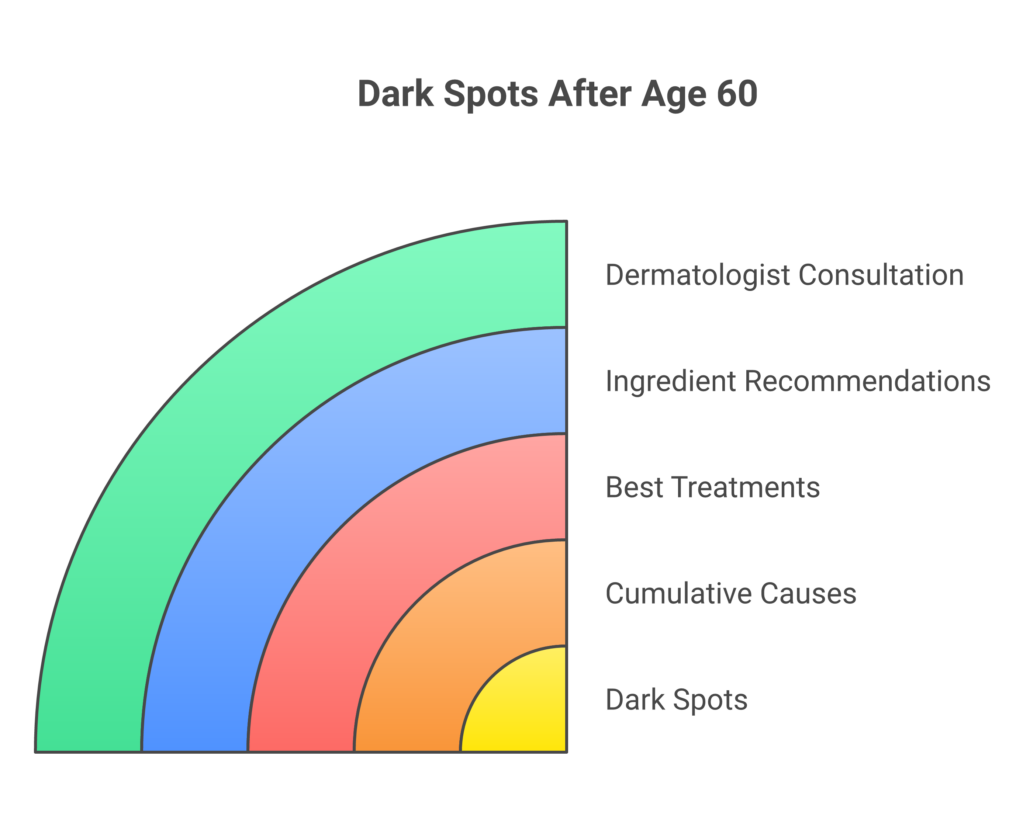
This guide covers why liver spots and brown spots become more common after 60, which treatments work best on mature skin, how to tell harmless patches from something that needs medical attention, and the daily habits that help prevent age spots from forming.
What Are These Age Spots and Liver Spots on My Skin After 60?
Those flat, oval patches ranging from light brown to dark brown are a common skin condition called hyperpigmentation – an overproduction of the natural pigment melanin concentrated in small areas. A dermatologist will typically classify them as solar lentigines (caused by cumulative sun damage) or seborrheic keratoses (slightly raised, waxy patches that are also benign). Unlike freckles, which tend to fade during winter months and appear in childhood, age spots and liver spots are permanent without treatment and show up later in life, usually after years of UV light exposure. Some patients confuse freckles with age spots, but freckles are genetic and typically smaller, while liver spots are caused by accumulated UV damage. Sun spots is another common name, though dermatologists prefer the clinical term solar lentigines.
You’ll hear several names used interchangeably. Age spots, liver spots, sun spots, and brown spots all describe the same flat dark areas of increased pigmentation. Despite the name, the term liver spot has nothing to do with your liver. These spots are purely a result of how the skin responds to ultraviolet UV light over time.
Where Age Spots and Liver Spots Appear Most Often
Age spots develop most frequently on skin that’s had the most cumulative sun exposure:
- Face and forehead – especially the cheeks, temples, and around the eyes
- Back of the hands, shoulders and arms – some of the earliest and most visible locations for liver spots
- Shoulders and upper back – from years of outdoor activities without sun protection
- Forearms and arms – often overlooked during sunscreen application
- Chest, neck, and legs – a common concern for women over 60
People with light skin and light skin tend to develop age spots earlier and more visibly. But age spots affect people of all skin types and skin tones. Those with darker skin may notice spots that appear more gray or ash-colored rather than brown, which makes accurate skin tone assessment critical before choosing a treatment approach. Darker skin tones are also more prone to post-inflammatory hyperpigmentation from acne scarring, acne breakouts, rosacea flares, or minor injuries. So the type of discoloration and your skin tone both matter when choosing treatments.
Why Age Spots and Liver Spots Become More Common After 60
Your skin keeps a receipt for every sunburn and every hour of unprotected sun exposure. Here’s what’s happening beneath the surface.
Cumulative Sun Damage Is the Primary Cause
Ultraviolet UV radiation from the sun (though radiation therapy for cancer can also trigger spots)’s rays triggers melanocytes, the cells responsible for melanin production, to ramp up pigment output. When you’re young, melanin disperses evenly across your skin. But after decades of sun exposure and sun damage, melanocytes become overactive pigment cells that cluster and misfire, creating concentrated dark patches that show up as age spots and liver spots.
A 2005 study published in Skin Research and Technology confirmed that cumulative ultraviolet UV light exposure is the primary cause of visible skin changes in adults over 60, with sun exposed areas showing far more pigmentation irregularity than sun-protected skin. The liver spots appearing now are the result of sun damage from 20, 30, even 40 years ago. Tanning beds and commercial tanning lamps cause the same UV radiation damage as natural sunlight, and people who used tanning beds regularly in their twenties or thirties often develop more age spots by their sixties.
Slower Skin Cell Turnover
In your twenties, your skin cell turnover cycle takes about 14-21 days. By your fifties and sixties, that cycle stretches to 45-90 days, according to dermatological research on epidermal renewal. Pigmented cells and dead skin cells sit on the outer layer of your skin much longer. The slower this process, the more stubborn those liver spots and brown spots become, and the harder they are to lighten without professional treatment.
Thinning Skin Makes Spots More Visible
After 60, your epidermis (the outer layer of skin) thins at a rate of roughly 6.4% per decade, according to a morphometric analysis published in Skin Research and Technology. Thinner skin means less tissue between melanin deposits and the surface, so liver spots that were subtle at 50 become dramatically more noticeable at 65. This thinning also means your skin is more vulnerable to further sun damage, wrinkles, and reduced collagen production and blood vessels.
Hormonal Changes and Genetics
Post-menopausal hormonal changes influence melanin production. A drop in estrogen affects the hormones that regulate skin pigmentation, sometimes leading to new age spots and liver spots. Genetics play a role too, if your parents had age spots early, you’re more likely to develop age spots yourself. Other factors like certain medications can also increase pigmentation sensitivity.
Are Age Spots Dangerous? Telling Benign Liver Spots from Skin Cancer
Most age spots and liver spots are harmless, people remove them for cosmetic reasons rather than medical reasons. Many individuals treat age spots, sunspots, and sun spots purely for cosmetic reasons, and that’s completely valid. But skin cancer can disguise itself as an innocent-looking spot. The American Cancer Society reports the average age of melanoma diagnosis is 66.
That’s why every new or changing spot deserves a second look from a doctor.
The ABCDEs of Melanoma
Use this checklist to evaluate any spot that concerns you:
| Letter | What to Check | Harmless Age Spot | Warning Sign |
|---|---|---|---|
| A – Asymmetry | Is one half different? | Symmetrical, uniform shape | One half doesn’t match |
| B – Border | Smooth or irregular border? | Smooth, well-defined edges | Ragged, notched, or blurry irregular border |
| C – Color | Consistent color? | Uniform tan or brown | Multiple colors (brown, black, red, white) |
| D – Diameter | How large? | Smaller than 6mm | Larger than a pencil eraser (6mm+) |
| E – Evolving | Changed recently? | Stays the same over time | Growing, changing color or shape |
If a spot is itching, bleeding, crusting, or rapidly changing, schedule a skin cancer screening right away. The risk of melanoma and other cancerous growths increases after 60. Annual skin checks are essential for anyone in this age group, especially those with a medical history of sunburns, excessive sun exposure, or tanning beds use.
Best At-Home Treatments to Get Rid of Age Spots on Mature Skin
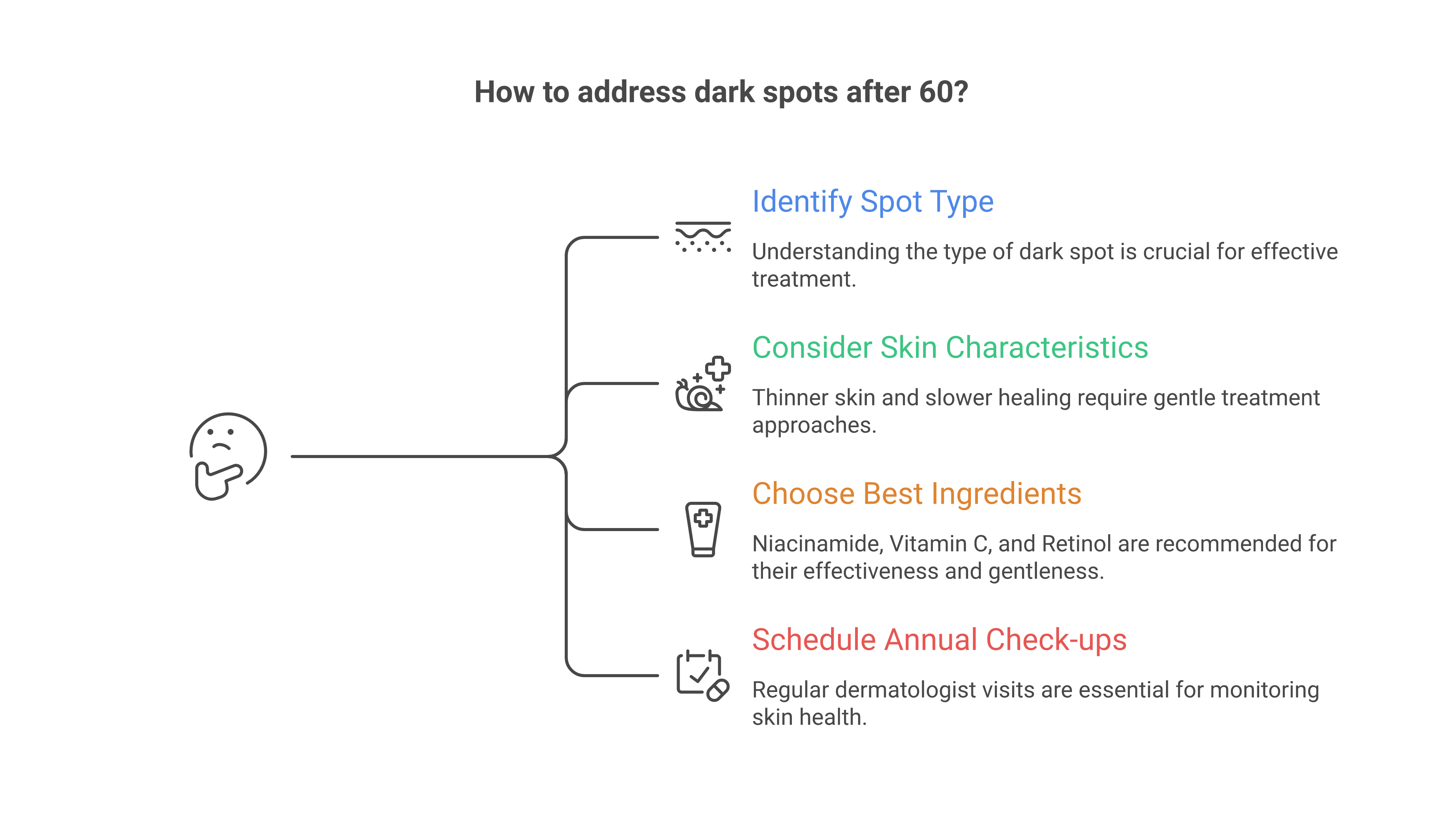
Mature skin after 60 is thinner, drier, and more sensitive. That changes which treatment options and skin care products work safely. The goal is to lighten age spots and fade age spots without irritation. Consistency matters more than intensity. I’ve seen far better results from gentle daily use than aggressive topical creams that leave skin raw. You can get rid of age spots at home with over the counter products. It just takes the right approach for your skin type.
Vitamin C Serums
Vitamin C (L-ascorbic acid at 10-20%) is one of the most effective brightening ingredients for all skin types. It inhibits tyrosinase, the enzyme driving melanin production, and works on age spots, freckles, and post-acne marks alike. A 2017 systematic review in the Journal of Clinical and Aesthetic Dermatology confirmed topical vitamin C reduces UV-induced pigmentation across 31 randomized controlled trials. For mature skin, look for formulas combining vitamin C with vitamin E (a complementary antioxidant) and ferulic acid, antioxidants that protect against premature aging and further sun damage. Apply every morning before sunscreen to help lighten dark spots and get rid of age spots gradually. Learn more about how to fade dark spots, each dark spot, on your face.
Retinol (Start Low, Go Slow)
Retinol accelerates cellular renewal, pushing pigmented cells to the surface faster so they shed. But mature skin over 60 needs a gentler approach. Start with 0.25% retinol every third night and gradually increase over 4-6 weeks. Skip the 1% concentrations marketed to younger skin types, they’ll cause irritation and peeling on thinner aging skin. A 2020 clinical trial published in Skin Pharmacology and Physiology found that 0.3% and 0.5% retinol serums applied over 8 weeks reduced visible signs of photoaging, including dark brown spots and uneven skin tone. Retinol is one of the best skin lightening treatments for liver spots, but patience is essential.
Niacinamide
My top recommendation for sensitive mature skin. Niacinamide (vitamin B3) at 5% reduces melanin transfer from melanocytes to surrounding skin cells without irritation. A 2002 study by Hakozaki et al. In the British Journal of Dermatology found niacinamide inhibited melanosome transfer by 35-68% in laboratory models, and a follow-up clinical trial demonstrated significant reduction in hyperpigmentation and liver spots after 4-8 weeks. Niacinamide also strengthens the outer layer of your skin barrier, critical when it’s already compromised by age.
Alpha Arbutin
A gentler alternative to hydroquinone, alpha arbutin blocks tyrosinase to reduce melanin production. It’s well-tolerated across all skin tones and pairs well with vitamin C at 2% concentration twice daily. For those who want to lighten age spots but can’t tolerate stronger skin lightening treatments, alpha arbutin is a reliable starting point.
Glycolic Acid (AHA Exfoliation)
Glycolic acid helps remove dead skin cells from the outer layer and top layer of skin, revealing more even skin tone beneath. For skin after 60, stick to 5-10%, lower than what younger skin types tolerate. Use 2-3 times per week, never on retinol nights. Exfoliation speeds up how quickly you can get rid of age spots and liver spots by clearing pigment-trapping cells from the surface.
Hydroquinone
Hydroquinone remains the gold standard for serious hyperpigmentation. Over the counter formulas come in 2%; prescription creams go up to 4%. Use in 3-month cycles only, prolonged use can paradoxically darken skin (a condition called ochronosis). Consult with a dermatologist before starting, especially if you have darker skin, as complications are more common with certain skin types and tones.
What About Home Remedies?
Lemon juice, apple cider vinegar, aloe vera, and turmeric masks appear in home remedy guides for dark spots, but the clinical evidence is weak. Lemon juice can cause chemical burns and increase sun sensitivity. Apple cider vinegar is too acidic for mature skin. Aloe vera may soothe skin but won’t meaningfully lighten liver spots or age spots. Home remedies aren’t effective skin lightening treatments. Stick with proven actives backed by clinical research. They’re what actually lighten dark spots and fade age spots.
Professional Treatments and Lasers to Get Rid of Age Spots
When at-home products and topical treatments aren’t enough, professional procedures and medical treatments offer faster results. Here’s a comparison of the main treatment options:
| Treatment | How It Works | Sessions | Downtime | Cost | Best For |
|---|---|---|---|---|---|
| IPL Lasers | Intense pulsed light lasers break up melanin | 2-4 | 1-3 days | $300-$600 | Widespread age spots and liver spots |
| Q-Switched Lasers | Targeted lasers shatter pigment | 1-3 | 5-7 days | $400-$800 | Stubborn, deep liver spots |
| Chemical Peels | Chemical solution removes outer skin layers | 3-6 | 3-14 days | $150-$400 | Multiple age spots, overall skin tone |
| Cryotherapy | Liquid nitrogen freezes spots | 1-2 | 1-2 weeks | $100-$300 | Individual, isolated age spots |
| Microdermabrasion | Crystals remove dead skin cells | 6-10 | None | $100-$250 | Mild liver spots, maintenance |
Laser Therapy and Laser Treatments
Laser treatment with lasers is the most effective approach to get rid of age spots and liver spots. IPL lasers target melanin across larger areas, while Q-switched lasers deliver concentrated pulses to individual spots. Both types of lasers shatter pigment particles, which your body clears naturally over the following weeks. Laser therapy with modern lasers can eliminate spots in 1-2 sessions, though some stubborn liver spots require follow-up laser treatments. Read our in-depth guide on laser treatments for age spots.
One caveat about lasers: laser treatments carry higher risk on darker skin tones. Ask your dermatologist about Nd:YAG lasers, which are safer for pigmented skin types. The right type of lasers makes all the difference for avoiding post-inflammatory hyperpigmentation after treatment.
Chemical Peels
Chemical peels use a chemical solution (glycolic acid, salicylic acid, lactic acid, or trichloroacetic acid) to dissolve the pigmented top layer and outer layer. They come in three depths:
- Superficial peels (glycolic acid, 30-50%), minimal downtime, good for mild age spots
- Medium peels (TCA at 15-35%), require 5-7 days recovery but lighten age spots significantly
- Deep peels (phenol-based), rarely recommended for skin over 60 due to prolonged healing and risk
According to the American Academy of Dermatology, about 47% of patients receiving chemical peels achieved 50% fading of age spots. Chemical peels remain cost-effective medical treatments for getting rid of age spots and liver spots across larger areas of skin, and they treat age spots that resist topical treatments and over the counter products.
Cryotherapy
A dermatologist applies liquid nitrogen to individual spots for 5-15 seconds. The frozen skin blisters, scabs, and heals lighter. Cryotherapy works best for isolated age spots and liver spots rather than widespread hyperpigmentation. It can’t treat age spots across large areas efficiently.
Microdermabrasion
The gentlest professional option. A device sprays fine crystals to remove dead skin cells from the surface. You’ll need 6-10 sessions of microdermabrasion to see improvement on liver spots and age spots, but there’s zero downtime. According to the AAD, about 40% of patients who had microdermabrasion twice a week for 16 weeks saw their age spots disappear completely.
How to Protect Your Skin: Sun Protection as Your Best Defense to Prevent Age Spots
Every treatment in this guide becomes pointless without daily sun protection. Sun exposure will darken existing liver spots and create new age spots faster than any product can lighten or fade them. If you want to prevent age spots, sun protection has to come first.
Sunscreen Is Non-Negotiable
Apply a broad spectrum sunscreen with at least SPF 30 every morning, even on cloudy days. UVA rays from the sun’s rays penetrate clouds and window glass year-round. For mature skin, mineral broad spectrum sunscreen formulas (zinc oxide or titanium dioxide) are less irritating than chemical solutions. The American Academy of Dermatology recommends you apply sunscreen generously, a nickel-sized amount for your face alone. Reapply every two hours when outdoors, or more often if you’re swimming or perspiring. Don’t forget your hands. They develop age spots and liver spots faster because they’re chronically exposed to the sun.
Wear Protective Clothing and Limit Time Outdoors
Sunscreen alone isn’t maximum sun protection. Wear sun protective clothing and use sun protection factor-rated fabrics whenever possible to prevent age spots:
- Wide brimmed hats (3+ inches) that shade face, ears, and neck. They provide more protection than a baseball cap or golf visor
- Wear tightly woven clothing or clothes with an ultraviolet protection factor (UPF) of 50+, much more reliable for sun protection than regular tightly woven fabrics alone
- Sunglasses with UV protection to shield skin around the eyes
- Long sleeved shirts and long sleeves during extended sun exposure and outdoor activities
Harmful UV rays and UV radiation peak between 10 a.m. And 4 p.m. Even 15 minutes of unprotected midday sun exposure during peak sun hours can trigger melanocyte activity and increased melanin production. Seek shade during peak sun hours. Schedule outdoor activities for early morning or late afternoon to avoid the strongest UV rays. These steps help prevent age spots and protect against more sun damage and further sun damage to aging skin.
A Skin Care Routine for Age Spots and Liver Spots After 60
Here’s a realistic daily routine that targets age spots without overwhelming mature skin:
Morning Routine
- Gentle cleanser – cream or milk formula to remove dirt without stripping moisture
- Vitamin C serum (10-20%), pat onto clean skin for brightening and sun protection
- Moisturizer – ceramides and hyaluronic acid to support the outer layer and maintain healthy skin
- Broad spectrum sunscreen with at least SPF 30, use sunscreen daily, every day
Evening Routine
- Gentle cleanser – remove sunscreen buildup
- Treatment (alternating nights): Retinol or glycolic acid, never both the same night
- Niacinamide serum – safe every night, helps lighten dark spots over time
- Rich night cream – heavier than morning formula to support skin repair
Want more details? See our 20 anti-aging skincare tips that actually work.
Patience Is Part of the Treatment
Topical treatments take 8-12 weeks before you see results on age spots and liver spots. That reflects the time needed for the full cellular cycle from the deepest layer of skin to the surface. After 60, expect closer to 12-16 weeks because of slower skin cell turnover. If liver spots and age spots haven’t improved by 16 weeks, consult a dermatologist about chemical peels, laser therapy with lasers, or prescription options for your skin condition.
When to See a Dermatologist or Doctor About Age Spots
Schedule a visit with a dermatologist or doctor if you notice these changes to existing age spots, liver spots, or dark patches:
- A spot that’s rapidly growing over weeks or months
- Multiple colors within a single spot (black, red, or white mixed with brown)
- Irregular border, jagged, or poorly defined borders, signs of potential melanoma
- A spot that’s bleeding, crusting, itching, or painful without obvious cause
- Any new, very dark spot that appears suddenly
- Spots with a raised or firm texture different from your typical flat age spots
Annual skin checks matter even when liver spots seem normal. A dermatologist uses dermoscopy to see structures invisible to the naked eye and can determine if a spot requires treatment or a biopsy. The Skin Cancer Foundation recommends annual full-body skin exams for all adults, especially individuals with a history of excessive sun exposure, tanning beds, or skin cancer. Don’t wait for obvious signs to schedule a consultation. A doctor who evaluates your age spots early can catch new skin changes before they become a serious medical concern.
Learn more about when a dermatologist can help with dark spots on your face.
Frequently Asked Questions About Age Spots After 60
Can you completely get rid of age spots after 60?
Yes, in many cases. Laser therapy with modern lasers and cryotherapy can remove individual liver spots in 1-3 sessions. Topical treatments fade age spots significantly. Most people achieve 60-80% improvement with topicals and 80-95% with professional laser treatments. Consistent sun protection and sunscreen use keeps age spots from returning.
What is the best dark spot remover for sensitive mature skin?
Niacinamide at 5% is the safest starting point for sensitive mature skin. For stronger results on age spots and liver spots, add vitamin C in the morning and low-dose retinol at night. Our guide to dark spot removers for sensitive skin covers specific product recommendations.
Why am I suddenly getting a lot of age spots?
It feels sudden, but it’s decades of sun exposure and sun damage catching up. After 60, melanocyte regulation declines and previously invisible pigment deposits become visible as age spots and liver spots. Hormonal changes after menopause trigger new age spots too. Tanning beds use earlier in life accelerates this process.
Do liver spots keep appearing as you get older?
Yes. Without consistent sun protection, new liver spots will continue to develop throughout your sixties, seventies, and beyond. The melanocyte damage causing these spots is cumulative. But daily sunscreen, wearing protective clothing, and avoiding peak sun hours dramatically slows new liver spot formation. You can prevent age spots from forming even if you already have them.
What vitamin helps with age spots?
Topical vitamin C is the most effective vitamin for fading age spots and liver spots. Applied as a serum, it inhibits melanin production and protects against future sun damage. Oral vitamin C doesn’t concentrate in skin enough to affect pigmentation. Niacinamide (vitamin B3) also helps reduce liver spots and lighten age spots over time.
Does retinol work on age spots for people over 60?
Yes. Retinol has clinical evidence for reducing visible signs of photoaging, including liver spots and dark brown patches. A 2020 controlled trial found 0.3% and 0.5% retinol serums improved hyperpigmentation after 8 weeks of use. For over-60 skin, start with 0.25% retinol and build tolerance gradually. This avoids irritation while still helping you get rid of age spots.
Are age spots on the hands harder to treat?
Somewhat. Hand skin is thinner and heals more slowly, and the hands are one of the areas exposed to the sun most frequently. But vitamin C, retinol, niacinamide, and chemical peels all work on hand spots and liver spots. The biggest challenge is sun protection. Most people wash sunscreen off their hands repeatedly. Unlike freckles on the hands, which can be charming, liver spots on hands tend to be larger and more uneven. Reapplying after handwashing and wearing protective clothing like gloves during outdoor activities helps existing age spots fade faster.
