
Age Spots vs Sun Spots vs Liver Spots: Are They Actually Different?

Dr. Matthew Olesiak, MD, is the Chief Medical Director at SANESolution, a renowned wellness technology company dedicated to providing evidence-based solutions for optimal living. Dr. Olesiak earned his medical degree from the prestigious Jagiellonian University Medical College in Kraków, Poland, where he developed a strong foundation in medicine.
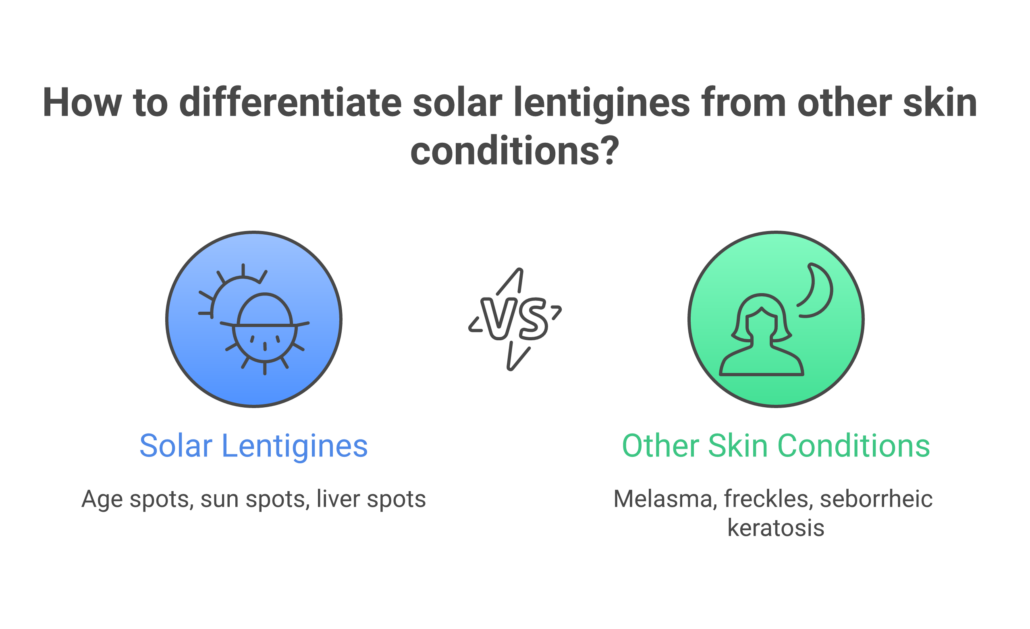
Age spots, sun spots, liver spots — three names that get tossed around like they’re describing completely different skin conditions. But here’s what most people don’t realize: age spots vs sun spots vs liver spots is actually a trick question. All three terms describe the exact same thing. They’re flat, tan to brown patches of increased pigmentation caused by years of accumulated UV damage, and their medical name is solar lentigines. The difference between age spots, sun spots, and liver spots? Nothing. Just different labels people slap on the same condition depending on context.
That said, this answer alone doesn’t help you much. What you really need to know is why these spots appear, how to tell them apart from something dangerous like melanoma or actinic keratosis, and what actually works to fade or remove them. I’ve spent years researching skin pigment disorders, and I can tell you the confusion around these terms runs deep — even among skin care professionals. So let’s clear it all up.
Why Do These Spots Have Three Different Names?
The reason we have three names for one condition comes down to history, misunderstanding, and common observation. Each name tells a different part of the story, but all three describe the same skin changes.
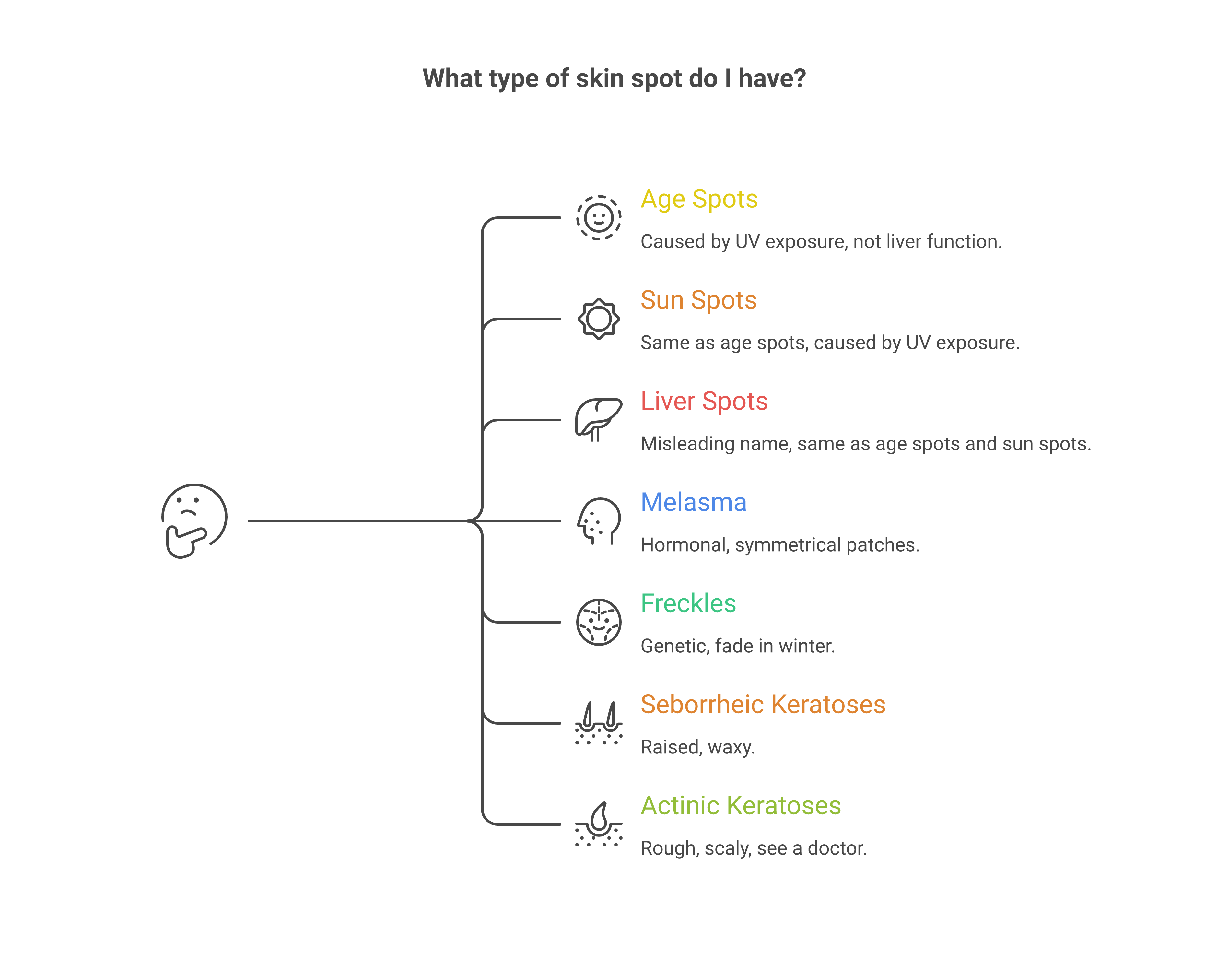
“Age spots” became popular because these spots and sun damage accumulate over decades, making them most visible in adults older than 50. About 90% of light-skinned people over age 60 have at least one solar lentigo, according to a 2025 systematic review published in PMC. So naturally, people assumed age caused them. The reality is that age correlates with sun exposure — older adults have simply had more time in the sun.
“Sun spots” is the more accurate nickname. These brown spots appear on areas of skin most exposed to the sun — particularly the face, the backs of hands, shoulders and arms. The connection between spots and sun is direct and well-documented. Wherever sun hits skin repeatedly over time, sunspots follow. Some dermatologists also use “sunspots” informally, though the term can cause confusion with a completely different condition called sunspots or actinic keratosis — rough, scaly patches that actually carry skin cancer risk (more on that below).
“Liver spots” is the oldest and most misleading term. Centuries ago, people believed these brown patches were connected to liver disease or poor liver function. They’re not. The name stuck purely because the brown color sometimes resembles liver tissue. Your liver has absolutely nothing to do with these marks appearing on your skin. Liver spots are harmless age spots by another name.
The correct medical term is solar lentigines (singular: solar lentigo). “Solar” refers to the sun. “Lentigo” comes from the Latin word for lentil, describing the small, flat shape of these spots. Cosmetic dermatology specialists and dermatologists use this term because it accurately identifies the cause — ultraviolet UV light — without any of the confusion the common names carry.
What Exactly Are Solar Lentigines?
Solar lentigines are areas of hyperpigmentation where melanocytes (the cells that produce the skin pigment melanin) have been pushed into overdrive by years of UV damage. The natural pigment melanin pools in concentrated areas of the top layer of the epidermis, creating visible flat brown spots. Unlike freckles, which tend to fade in winter and darken in summer, true age spots stay put year-round. They don’t come and go with the seasons.
How Age Spots Look
Here’s what to watch for when checking your skin health:
- Color: Ranges from light tan to dark brown, and occasionally nearly black on darker skin tones
- Shape: Oval or irregularly rounded, with well-defined borders
- Size: Typically 2mm to 13mm across, though they can cluster together and appear larger
- Texture: Completely flat against the surrounding skin — not raised, rough, or bumpy
- Location: Almost exclusively on areas exposed to the sun — face, hands, arms, shoulders, neck, and scalp (in people with thinning hair)
Unlike freckles, which are usually smaller and scattered, harmless age spots tend to be larger and more defined. They also don’t fade during months with less sunlight. Once they appear, they’re permanent unless treated with topical creams or professional cosmetic treatments.
The Real Cause: Cumulative Sun Damage
Every minute your skin spends in the sun’s rays, whether through prolonged sun exposure at the beach or incidental daily UV contact, ultraviolet UV light penetrates the epidermis and triggers melanin production. Melanin is your body’s natural sunscreen — it absorbs UV radiation to protect deeper skin layers from DNA damage. But after years of repeated sun exposure, certain clusters of melanocytes become permanently overactive. They produce excess melanin that pools together, creating the visible patches we call sunspots.
Here’s what many people miss: the ultraviolet damage is cumulative. That sunburn you got at age 15? Those summers you spent lifeguarding without sunscreen? The daily walks without UV protection? It all adds up. According to The Skin Cancer Foundation, roughly 23% of lifetime UV exposure occurs before age 18. The spots just don’t become visible until decades later, often in middle age or beyond.
Key Risk Factors for Sun Spots
Not everyone develops liver spots at the same rate. Several treatment plan considerations and risk factors determine who gets them sooner and more severely:
- Fair or light skin: People with lighter complexions (Fitzpatrick skin types I-III) and a lighter skin tone produce less protective melanin overall, putting them at higher risk of visible spots and skin cancer
- History of sunburns: Even a few severe sunburns dramatically increase your chances of developing brown spots later
- Age over 50: Though sunspots can appear as early as your 30s, they become most common after 50 when decades of UV damage finally surfaces
- Tanning beds: Artificial UV radiation from tanning beds causes the same melanin damage as natural sunlight — sometimes faster, since the UV intensity is concentrated
- Genetics: Some families are more prone to hyperpigmentation than others. Your genes influence how much pigment your melanocytes produce in response to UV exposure
- Medications: Certain antibiotics, diuretics, and retinoids can increase sun sensitivity, making spots more likely to develop with even moderate time outdoors
Age Spots vs. Actinic Keratosis: The Dangerous Lookalike
Harvard Health dermatologist Dr. Toni Golen points out that one of the most important distinctions isn’t between the three names for age spots — it’s between harmless solar lentigines and actinic keratosis, also sometimes called sunspots in casual conversation. Both appear on sun-exposed areas like the face, hands, shoulders and arms, but they’re fundamentally different conditions with different health implications.
The critical difference? Texture. True age spots feel completely smooth and flat against surrounding skin. Actinic keratoses feel rough, scaly, or sandpapery to the touch. This matters because actinic keratoses are precancerous lesions that can develop into squamous cell skin cancer if left untreated. If you notice any rough-textured spot on your skin, schedule a dermatologist evaluation — don’t assume it’s just a benign age spot.
Age Spots vs. Freckles vs. Moles vs. Melanoma: The Comparison That Matters
The critical comparison isn’t between the three names for age spots — it’s learning how to tell the difference between benign spots and conditions that look similar but could be cancerous. This distinction can be life-saving.
| Feature | Age Spots (Solar Lentigines) | Freckles (Ephelides) | Moles (Nevi) | Melanoma |
|---|---|---|---|---|
| Color | Tan to dark brown, uniform | Light brown to reddish | Brown, tan, black, pink | Multiple colors (brown, black, red, white, blue) |
| Shape | Oval, well-defined borders | Small, round, scattered | Round or oval, symmetrical | Asymmetrical, irregular borders |
| Texture | Flat, smooth | Flat | Flat or slightly raised | May be raised, uneven, or crusted |
| Size | 2mm to 13mm typically | 1-2mm | Under 6mm usually | Often larger than 6mm (pencil eraser) |
| Changes Over Time | Stable once formed | Fade in winter, darken in summer | Slow, minimal change | Evolves — grows, changes color, shape |
| Cause | Cumulative sun exposure | Genetics + sun exposure | Clusters of melanocytes | DNA mutation in melanocytes |
| Are They Dangerous? | No — benign | No — benign | Rarely (atypical moles can be precancerous) | Yes — potentially fatal if untreated |
The ABCDEs of Melanoma: A Self-Check You Should Know
Age spots themselves are typically harmless. They don’t become skin cancer. However, a melanoma can look like an age spot in its early stages, which is why having a dermatologist examine any suspicious spot matters. Look for these sign changes:
- A — Asymmetry: One half of the spot doesn’t match the other half
- B — Border: Edges are ragged, notched, blurred, or irregular rather than smooth
- C — Color: The spot contains multiple colors — mixtures of brown, black, tan, red, white, or blue within the same lesion
- D — Diameter: The spot is larger than 6mm across (about the size of a pencil eraser), though melanomas can be smaller
- E — Evolving: The spot is changing in size, shape, color, or texture over weeks or months
As a general rule, if any spot on your body matches one or more of these criteria, schedule a dermatologist evaluation promptly. Melanoma is the most aggressive form of skin cancer, but early detection leads to a 5-year survival rate above 99% when caught before it spreads, according to the American Cancer Society.
Age Spots vs. Melasma: Another Common Confusion
People frequently confuse age spots with melasma, but these are distinct conditions. Solar lentigines are small, well-defined flat spots caused by UV damage alone. Melasma appears as larger, blotchy patches with irregular borders, typically across the cheeks, forehead, and upper lip.
The key difference: melasma is triggered by hormonal changes combined with sun exposure, making it far more common in women — especially during pregnancy, while taking birth control pills, or during menopause. Melasma can also improve on its own when hormonal triggers resolve, while age spots never fade without active treatment.
Side-by-Side: All Three Names Compared
For anyone still wondering whether there’s any difference between age spots, sun spots, and liver spots, this table breaks it down definitively:
| Characteristic | Age Spots | Sun Spots | Liver Spots |
|---|---|---|---|
| Medical name | Solar lentigines | Solar lentigines | Solar lentigines |
| Cause | Cumulative sun exposure | Cumulative sun exposure | Cumulative sun exposure |
| Related to the liver? | No | No | No |
| Appearance | Flat, tan to brown | Flat, tan to brown | Flat, tan to brown |
| Common age group | 50+ (but can appear earlier) | 50+ (but can appear earlier) | 50+ (but can appear earlier) |
| Common locations | Face, hands, arms, shoulders | Face, hands, arms, shoulders | Face, hands, arms, shoulders |
| Cancerous? | No | No | No |
| Treatment needed? | Cosmetic only | Cosmetic only | Cosmetic only |
The table makes it obvious — there’s zero clinical difference. These are three names for one condition. If your doctor says “solar lentigines,” your mother says “liver spots,” and your friend says “age spots,” they’re all describing the same flat, brown spots on your skin.
How to Get Rid of Age Spots: Treatments That Actually Work
Age spots don’t require treatment since they aren’t dangerous, skin tags and moles are similarly benign growths. But many people want them gone for cosmetic reasons, and I completely understand that. Having visible spots on your skin — your face or hands especially — can affect confidence. Here are the treatment options, ranked from least to most aggressive.
At-Home Topical Creams and Over-the-Counter Treatments
These work best for mild to moderate spots and require consistent use over 2-6 months to show visible results:
- Vitamin C serums: A powerful antioxidant that inhibits melanin production and brightens existing spots. Look for L-ascorbic acid at 10-20% concentration. I’ve seen consistent results with daily use over 8-12 weeks
- Niacinamide (Vitamin B3): One of the most effective ingredients for reducing melanin transfer from melanocytes to surrounding skin cells. Effective at 5% concentration and gentle enough for sensitive skin
- Alpha arbutin: A natural melanin inhibitor derived from bearberry plant. Safer than hydroquinone with fewer side effects
- Kojic acid: Derived from fungi, it blocks tyrosinase (the enzyme needed for melanin production). Often combined with other brightening ingredients for enhanced results
- Retinoids: Vitamin A derivatives that accelerate cell turnover, gradually pushing pigmented cells to the surface where they shed. OTC retinol works slowly; prescription tretinoin is significantly stronger and more effective
- Hydroquinone (2%): Available over the counter at 2% concentration. Effective but should be used in 3-month cycles with breaks to avoid a condition called ochronosis (paradoxical darkening)
- Azelaic acid: Reduces melanin production while also treating acne and rosacea. A solid multi-tasking option
- Moisturizer with SPF: While not a treatment itself, using a daily moisturizer with sun protection prevents existing spots from getting darker and stops new ones from forming
For a deep comparison of the best options, check out our guide on the best dark spot removers for face.
Professional In-Office Cosmetic Treatments
When over-the-counter topical creams aren’t cutting it, professional treatments offer several treatment options that deliver faster, more dramatic results:
- Chemical peels: Chemical peels use concentrated acids (glycolic, TCA, or salicylic) to remove damaged outer skin layers, revealing less-pigmented skin underneath. Light peels require no downtime; medium peels need 5-7 days of recovery
- Laser treatments: Laser treatments target melanin directly using focused light energy. Intense pulsed light (IPL) and fractional lasers like Fraxel are the most common options. Most people need 2-4 sessions spaced 4-6 weeks apart. Expect some redness and mild crusting for 3-7 days post-treatment
- Cryotherapy: A dermatologist applies liquid nitrogen to freeze individual liver spots. The frozen tissue blisters, scabs over, and falls off within 1-2 weeks, revealing lighter skin beneath. Best for isolated spots rather than widespread areas
- Microdermabrasion: Uses fine crystals or a diamond tip to physically exfoliate the outer skin layer. Less aggressive than chemical peels or lasers, so multiple sessions are typically needed to reduce the appearance of spots
- Prescription hydroquinone (4%): Twice the strength of OTC versions. Used under dermatology supervision in 3-month cycles
Not sure which treatment route to take? Read more about dark spot treatment options for face to determine what matches your skin tone and budget.
How to Prevent Age Spots From Forming
Treating existing age spots is one thing. But the smartest prevention strategy is stopping new ones from appearing — and protecting treated skin from re-darkening. Prevention comes down to consistent UV protection. The relationship between spots and sun is cumulative — every hour of unprotected sun exposure adds to the total.
Sunscreen: Your Single Best Defense
Apply a broad spectrum sunscreen with SPF 30 or higher every single day. Not just beach days. Not just summer. Every day, including overcast ones — up to 80% of UV radiation penetrates clouds. Reapply every two hours when outdoors, and immediately after swimming or sweating.
Look for formulas containing zinc oxide or titanium dioxide (mineral sunscreens) or avobenzone and octisalate (chemical sunscreens). A broad spectrum sunscreen protects against both UVA rays (which cause aging and spots) and UVB rays (which cause sunburn and skin cancer risk). The best sunscreen is the one you’ll actually use consistently.
Wearing Protective Clothing and Seeking Shade
Wearing protective clothing creates a physical barrier that sunscreen alone can’t match:
- Wear tightly woven clothes in dark colors — loose-weave white fabrics let UV through
- Wide-brimmed hats (at least 3 inches) protect your face, ears, and neck
- Clothing with an ultraviolet protection factor (UPF) rating of 50+ blocks 98% of UV rays
- Sunglasses with UV400 protection shield the delicate skin around your eyes
Additional Sun Protection Strategies
- Avoid peak sun hours: The sun’s rays are strongest between 10 AM and 4 PM. Seeking shade during these hours significantly reduces your UV exposure. If your shadow is shorter than you are, UV intensity is high
- Skip tanning beds entirely: There’s no safe tan from artificial UV. Tanning beds deliver concentrated UV radiation that accelerates every type of damage, including age spots, wrinkles, and skin cancer risk
- Check your medications: Ask your pharmacist whether any of your medications increase photosensitivity. Common culprits include tetracycline antibiotics, certain blood pressure medications, and NSAIDs
- Provide sun protection for your hands: The backs of your hands, shoulders and arms receive enormous amounts of sun exposure throughout your life. Apply sunscreen to your hands after every hand wash, or wear UV-protective driving gloves
For a complete sun protection strategy, see our guide on 20 anti-aging skincare tips that actually work.
Special Considerations: Skin Changes on Different Body Areas
Age Spots on Hands
Hands are one of the most common places for liver spots — and age spots on hands are among the first sign people notice — because they receive constant, unprotected sun exposure during daily activities. Most people remember sunscreen for their face but forget their hands entirely. The skin on the backs of your hands is also thinner than on most of your body, making it more vulnerable to UV damage. If you already have spots on your hands, our article on how to remove dark spots covers techniques that work on hands too.
Age Spots on Face and Forehead
Facial sunspots — particularly the face and forehead and cheeks — are the most cosmetically concerning for most people. These areas are exposed to the sun daily and are difficult to cover with clothing. Treatment tends to be more cautious on the face because aggressive procedures carry a higher risk of post-inflammatory hyperpigmentation, particularly in individuals with darker skin tones.
Adults Older Than 50
If you’re over 50 and noticing new dark spots, you’re dealing with decades of accumulated UV damage finally coming to the surface. This is the prime demographic for solar lentigines. The good news: treatment options work at any age. A variety of topical creams and professional procedures can reduce the appearance of spots on hands, face, legs, feet, and shoulders. I’d recommend scheduling an appointment with a dermatologist to learn which approach is most beneficial for your specific situation. The key is combining active treatment with rigorous sun protection to prevent age spots from forming while you address existing ones.
What Deficiency Causes Liver Spots? Debunking the Myths
A common question I see is whether vitamin deficiencies cause liver spots. Let me be direct: no specific vitamin deficiency causes solar lentigines. These spots are caused by cumulative sun exposure, period.
That said, certain nutrients do play a supporting role in skin health and UV defense:
- Vitamin D: While sun exposure produces vitamin D, the amount needed is minimal — about 10-15 minutes a few times per week. Extended time outdoors beyond that doesn’t produce extra vitamin D but does cause skin damage
- Vitamin C: Functions as an antioxidant that helps protect against UV-induced oxidative stress on skin and supports collagen production. Won’t prevent age spots on its own, but contributes to overall skin health
- Vitamin E: Another antioxidant that works synergistically with vitamin C to provide some photoprotection
No supplement replaces sunscreen and seeking shade. If someone tells you a vitamin can cure or prevent liver spots, they’re oversimplifying the biology. The important information to remember: protect your skin from UV light, and use proven topical creams or professional treatments to minimize the appearance of spots that already exist. If in doubt about any new or changing spot, don’t hesitate to schedule a consultation with a dermatologist who has expertise in pigmented lesions — they can confirm whether what you’re seeing is a harmless solar lentigo or something that requires further evaluation.
Frequently Asked Questions
Are liver spots and sun spots the same thing?
Yes. Liver spots, sun spots, and age spots are three names for the identical condition — solar lentigines. The name “liver spots” comes from an outdated and incorrect belief that these brown patches were caused by liver problems. They have no connection to liver function whatsoever. The spots are caused exclusively by accumulated sun exposure over many years.
Can age spots turn into cancer?
No, true age spots (solar lentigines) do not transform into skin cancer. They are completely benign. However, early-stage melanoma can sometimes resemble an age spot, which is why any new, changing, or unusual-looking spot should be evaluated by a dermatologist. Use the ABCDEs of melanoma (Asymmetry, Border, Color, Diameter, Evolving) as your self-check guide. Additionally, rough or scaly spots may be actinic keratoses rather than age spots, and those do carry skin cancer risk.
What is the difference between an age spot and a freckle?
Unlike freckles, age spots don’t fade in winter. Freckles (ephelides) are genetically determined, appear in childhood, and fluctuate with sun exposure throughout the year. Age spots appear later in life as a result of cumulative UV damage and remain permanent once formed. Age spots are also typically larger (2-13mm) compared to freckles (1-2mm) and have a more uniform, darker color.
At what age do you typically get age spots?
Most people first notice age spots after age 50, but they can develop as early as your 30s — especially if you have fair skin, a history of significant sun exposure, or have used UV beds. People who spend a lot of time outdoors, live in sunny climates, or grew up without consistent sun protection often develop spots earlier than average.
Does vitamin C serum help with sun spots?
Yes. Topical vitamin C (specifically L-ascorbic acid at 10-20% concentration) is one of the most effective over-the-counter ingredients for fading sunspots. It works by inhibiting the tyrosinase enzyme that drives melanin production. Results typically become visible after 8-12 weeks of daily use. For best results, apply vitamin C serum in the morning underneath your broad spectrum sunscreen.
How do you get rid of liver spots on your hands and face?
For mild spots, start with topical creams like vitamin C, niacinamide, alpha arbutin, or retinoids. Give them 2-4 months of consistent daily use. For stubborn or widespread liver spots, professional treatment options like chemical peels, laser treatments, IPL therapy, or cryotherapy deliver faster, more dramatic results. Always pair any treatment with daily broad spectrum sunscreen (SPF 30+) to prevent new spots and protect treated skin.
Are age spots dangerous?
No. Age spots are a cosmetic concern, not a medical one. They don’t itch, bleed, hurt, or pose any health risk. However, they signal that your skin has absorbed significant UV damage over the years — which does increase your overall risk for skin cancer and other conditions. So while the spots themselves are harmless, they serve as a visual reminder to take UV protection seriously and schedule regular skin checks with a dermatologist.

