
Retinol for Dark Spots: How It Works, Best Concentrations, and How to Use It

Dr. Matthew Olesiak, MD, is the Chief Medical Director at SANESolution, a renowned wellness technology company dedicated to providing evidence-based solutions for optimal living. Dr. Olesiak earned his medical degree from the prestigious Jagiellonian University Medical College in Kraków, Poland, where he developed a strong foundation in medicine.
You’ve probably heard that retinol for dark spots is one of the most effective topical treatments available. And honestly? That reputation is earned. I’ve spent years digging into the research on retinoids, testing different concentrations, and watching how skin cells respond to this vitamin A derivative over weeks and months. What I can tell you is this: retinol works. But it works on its own timeline, and only if you use it correctly.
Here’s what most articles won’t say upfront: retinol isn’t a quick fix. It won’t erase dark spots in a week. It won’t work at all if you skip sunscreen. And if you jump into a high retinol concentration too fast, you might actually make your dark spots on skin temporarily worse. So before you grab the first retinol serum you see, let’s walk through exactly how this ingredient works, which strength you actually need, and how to build a skincare routine that delivers real, lasting results.
What Are Dark Spots and Why Do They Form?
Dark spots, also called hyperpigmentation, are flat areas of skin that appear darker than the surrounding skin tone. They happen when clusters of skin cells produce excess melanin, the pigment that gives skin its color. The result is an skin discoloration and uneven skin tone that can range from light brown patches to deep, stubborn dark marks.
Several things trigger this excess melanin production:
- Sun exposure – UV radiation is the single biggest cause. Years of sun exposure damage skin cells and trigger melanin overproduction, leading to sun spots (also called age spots or solar lentigines). If you’re not using SPF daily, this is likely your main culprit.
- Post-inflammatory hyperpigmentation (PIH) – When skin heals from acne, cuts, burns, or any inflammation, it can leave behind dark spots after acne and other injuries. PIH is especially common in darker skin tones.
- Hormonal changes – Melasma creates larger patches of discoloration, often triggered by pregnancy, birth control, or hormone therapy. It tends to appear on the cheeks, forehead, and upper lip.
- Aging skin – As we get older, cumulative sun damage and slower skin cell turnover make dark spots more visible and harder to fade. Dark spots on face over 50 are extremely common for this reason.
Understanding what’s causing your dark spots matters because it shapes how you treat them. Sun spots respond differently than melasma, and acne scars have their own healing timeline. Retinol addresses all of these, but the mechanism is worth understanding before you start.
How Retinol Actually Fades Dark Spots: The Science
Retinol isn’t just another hyped skin care ingredient. It’s one of the most studied topical compounds in all of skin care, and researchers have been documenting its ability to fade hyperpigmentation since the early 1990s. A landmark 1993 study published in the British Journal of Dermatology found that 0.1% tretinoin (prescription-strength retinoid) improved hyperpigmentation in 68% of participants over 40 weeks. More recent research using over-the-counter topical retinol concentrations has shown similar benefits with gentler side effect profiles.
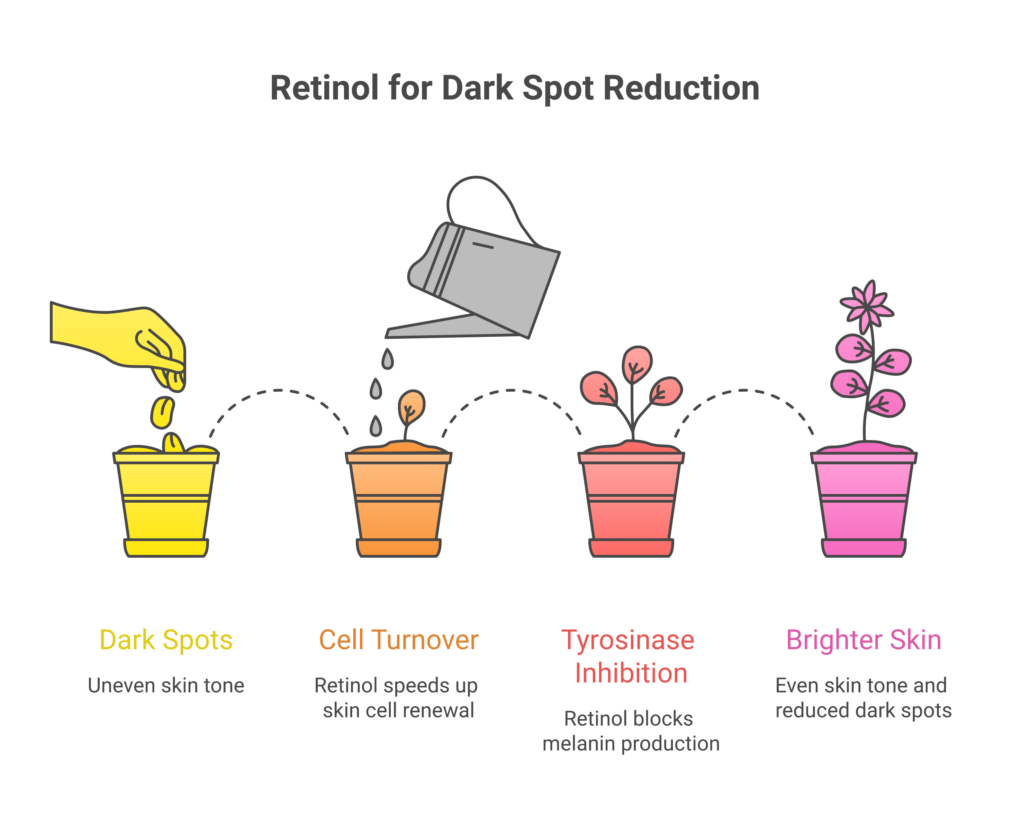
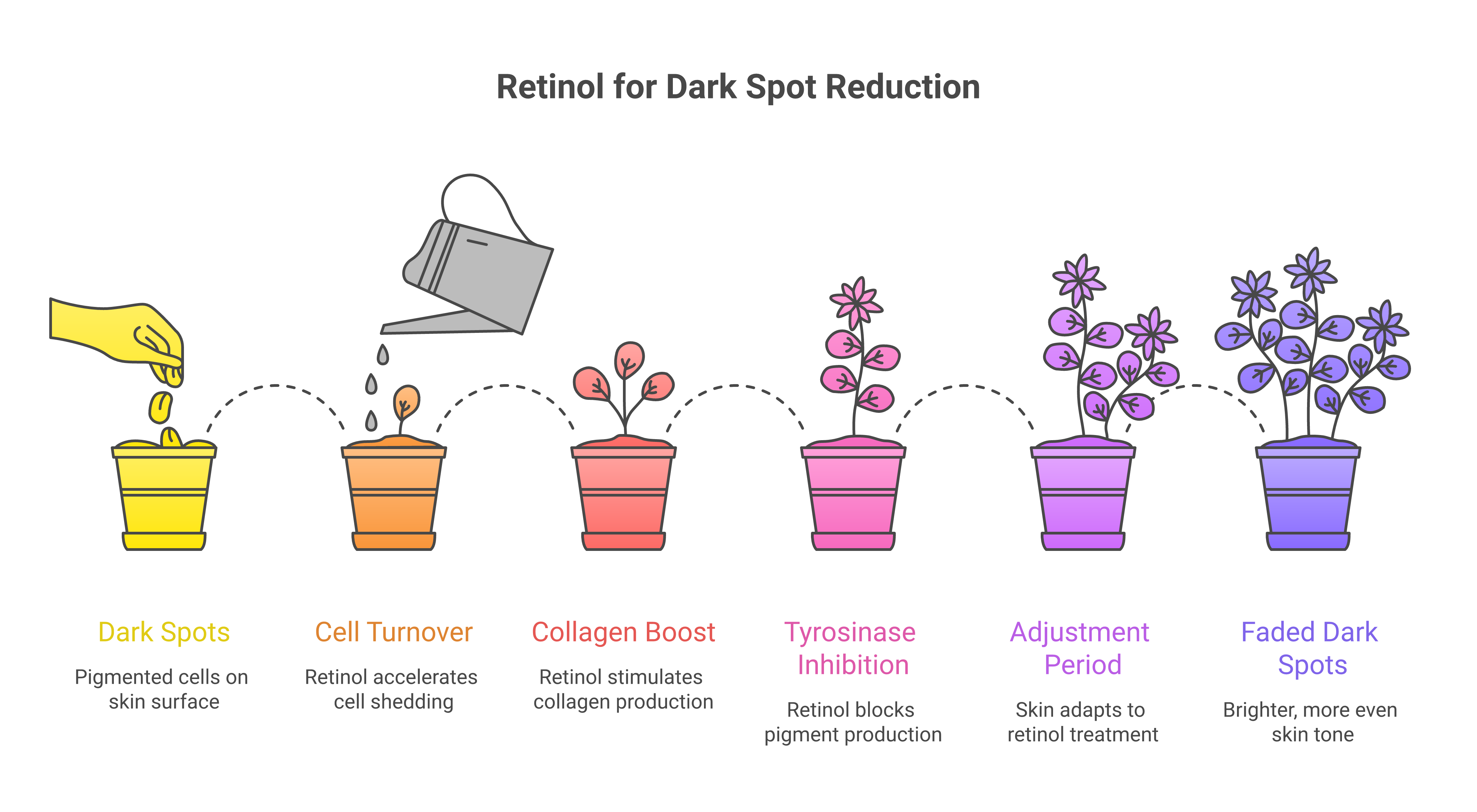
Here’s what retinol does inside your skin, broken down into three key mechanisms:
1. Accelerates Skin Cell Turnover
This is the primary way retinol attacks dark spots. Your skin naturally sheds dead skin cells and replaces them with new ones roughly every 28 days when you’re young. That cycle slows significantly with age, sometimes stretching to 40-60 days. When turnover slows, pigmented skin cells sit on the surface longer, making dark spots look more pronounced.
Retinol speeds up this skin cell turnover process. It signals your skin cells to divide faster, pushing the pigmented dead skin cells to the surface where they’re naturally shed. Think of it as hitting fast-forward on your skin’s natural exfoliation. Over weeks and months, those dark, pigmented layers are gradually replaced by fresher, more evenly toned skin cells underneath.
2. Inhibits Melanin Production
Retinol doesn’t just remove existing pigmented cells. It also helps prevent new dark spots from forming. When retinol converts to retinoic acid inside your skin cells, it inhibits tyrosinase, the enzyme directly responsible for melanin production. Less tyrosinase activity means less melanin being deposited into skin cells, which translates to fewer new dark marks and a more even skin tone over time.
A 2016 clinical trial published in the Journal of Drugs in Dermatology found that a regimen combining 0.5% retinol with vitamin C produced statistically significant decreases in hyperpigmentation scores after just 8 weeks. The improvement continued through the 12-week endpoint. This dual mechanism, removing old pigment and preventing new pigment, is what makes topical retinoids so effective compared to ingredients that only address one pathway.
3. Boosts Collagen Production
Here’s a benefit most people overlook: retinol stimulates collagen production (promoting collagen production is one of retinol’s key benefits) in the deeper layers of your skin. More collagen means thicker, healthier skin with improved skin texture. When your skin’s structure improves, dark spots become less visible against the backdrop of smoother, more resilient skin. Collagen production also helps with acne scars, which are both pigmented and textured, giving retinol a two-for-one advantage there.
Retinol vs. Retinoids vs. Tretinoin: Know What You’re Buying
Walk into any drugstore and you’ll see labels throwing around terms like “retinol,” “retinoid,” “retinal,” and “retinoic acid” almost interchangeably. They’re not the same thing. Understanding the difference will save you from wasting money on something too weak, or triggering serious skin irritation with something too strong.
The Retinoid Family, Ranked by Strength
All of these are topical retinoids, meaning they’re derivatives of vitamin A. But they differ in how quickly your skin can use them:
- Retinyl palmitate and retinyl esters – The gentlest forms. These need three conversion steps inside your skin cells before becoming active retinoic acid. They’re found in many basic skin care products and moisturizers. Effective? Barely. If you have sensitive skin and want to dip your toe in, they’re a starting point. But don’t expect dramatic results on stubborn dark spots.
- Retinol – The most popular over-the-counter retinol form. Needs two conversion steps to become active. Available in concentrations from 0.025% to 1.0%. This is the sweet spot for most people targeting hyperpigmentation without a prescription. A good retinol serum at 0.3-0.5% retinol concentration can deliver real results.
- Retinaldehyde (Retinal) – One conversion step away from retinoic acid, making it stronger than retinol but still available without a prescription. Studies suggest retinal works faster than standard retinol with comparable tolerability. If you’ve used retinol for 3-6 months and want to level up, retinal is the logical next step.
- Tretinoin (Retinoic Acid) – This is the active form. No conversion needed. Your skin cells use it immediately. Tretinoin is prescription-only and is considered the gold standard for treating hyperpigmentation, fine lines, and photoaging. It’s significantly more potent than OTC retinol, which means results come faster, but so does skin irritation.
- Adapalene – A synthetic retinoid originally developed for acne. Now available OTC at 0.1% (Differin). Research shows it can help with post-inflammatory hyperpigmentation, particularly from acne breakouts.
For most people reading this, a well-formulated retinol serum in the 0.3% to 0.5% range is the right starting point. If you’ve been using retinol consistently for 6+ months and plateaued, talk to your doctor about tretinoin.
Retinol Concentration Guide: Matching Strength to Your Skin
Retinol concentration matters. A lot. Too low and you’re waiting months for minimal improvement. Too high and you’re dealing with flaking, redness, and potentially worsening your dark spots through inflammation. Here’s how to think about it:
Beginner Level: 0.025% to 0.3%
Start here if you’ve never used any topical retinoids before, if you have sensitive skin, or if your skin tends to react to new skin care products. A 0.025% to 0.1% retinol concentration is genuinely gentle enough for most skin types, including sensitive skin that normally can’t tolerate active ingredients.
At this level, you’ll still see benefits. Dead skin cells shed a bit faster, skin texture starts improving, and very mild dark marks may begin to lighten after 8-12 weeks of consistent use. Think of this as your onboarding phase.
Intermediate Level: 0.3% to 0.5%
This is where most people see meaningful results on dark spots. A 0.5% retinol concentration is the dosage used in several published clinical trials showing significant improvement in hyperpigmentation. At this retinol concentration, skin cell turnover accelerates noticeably, melanin production slows, and collagen production gets a real boost.
You can move to this range after 4-8 weeks at a lower concentration, assuming your skin has adjusted without major skin irritation. People with oily skin often tolerate this range well from the start because their natural sebum production provides a built-in buffer against dryness.
Advanced Level: 0.5% to 1.0%
Higher retinol concentrations deliver faster results but carry more risk. A 2020 clinical study compared 0.3% and 0.5% retinol serums and found both effective, but the 0.5% concentration showed faster improvements in overall skin tone. The tradeoff: more dryness and flaking during the first 4-6 weeks.
Reserve the 1.0% retinol concentration for experienced users whose skin has already adapted to lower percentages. Even then, you might not need to go this high. Stronger isn’t always better, especially for dark marks on sensitive areas like the cheeks and forehead.
Retinol Serum vs. Retinol Cream: Which Formulation Works Better?
Both work. The difference is in delivery and feel. A retinol serum is typically lighter, absorbs faster, and can penetrate deeper into the skin. That makes serums a better choice for oily skin and for targeting deep-set dark spots. A retinol cream sits on the surface longer and provides more hydration, which makes it better for dry or sensitive skin types that need the extra moisture barrier.
My general recommendation? Start with a retinol serum if your primary concern is dark spots and uneven skin tone. Switch to or add a retinol cream if dryness becomes an issue during the adjustment period.
How to Use Retinol for Dark Spots: A Step-by-Step Guide
Getting results from retinol isn’t complicated, but there’s a right way and a wrong way. Most of the horror stories about retinol, the peeling, the redness, the “it made my skin worse” complaints, come down to using too much, too often, too soon. Follow this skincare routine and you’ll avoid those pitfalls:
Step 1: Start Low, Go Slow
Begin with a low retinol concentration (0.025% to 0.3%) and apply it just 2 nights per week for the first 2-3 weeks. This gives your skin cells time to adjust without overwhelming them. If you tolerate that well, increase to 3 nights per week, then every other night, and eventually nightly if your skin can handle it.
Step 2: Apply to Clean, Dry Skin at Night
Retinol breaks down in sunlight, which is why it belongs in your nighttime skin care routine. After cleansing, wait about 10-15 minutes for your skin to fully dry. Applying retinol to damp skin increases absorption, which sounds good in theory but dramatically increases the risk of skin irritation in practice.
Step 3: Use a Pea-Sized Amount
Squeeze out a pea-sized dot and distribute it across your entire face, not just on the dark spots. I know it’s tempting to load up on the spots themselves, but retinol works best when applied evenly. Using too much doesn’t speed up results; it just speeds up irritation. Avoid the eye area and corners of your mouth where skin is thinnest.
Step 4: Try the Sandwich Method (For Sensitive Skin)
If you have sensitive skin or are nervous about irritation, use the sandwich method: apply a thin layer of moisturizer first, then your retinol, then another layer of moisturizer on top. This buffers the retinol slightly, reducing its intensity without eliminating its effectiveness. It’s a great approach for the first month while your skin builds tolerance.
Step 5: Follow with Moisturizer
Wait 5-10 minutes after applying retinol, then layer on a moisturizer containing hydrating ingredients like hyaluronic acid and ceramides. These ingredients help protect skin barrier function and counteract the drying effects of retinol. A strong moisture barrier means less irritation and faster healing, both of which support your goal of fading dark spots.
Step 6: Sunscreen Every Single Morning (Non-Negotiable)
I can’t stress this enough. You must wear sunscreen with at least SPF 30 every morning when using retinol. Every. Single. Day. Even on cloudy days. Even if you’re “just running errands.” Retinol increases your skin’s sensitivity to UV radiation, and sun exposure is the number one cause of dark spots in the first place. Using retinol without sunscreen is like bailing water out of a boat with a hole in the bottom. You need to protect skin from UV damage or you’ll create new dark spots faster than you fade old ones.
Use a broad-spectrum sunscreen and reapply every 2 hours if you’re spending time outdoors. Limit sun exposure during peak UV hours (10 AM to 4 PM). This single step, daily sun protection, is what separates people who see significant results from people who give up on retinol after 3 months.
Managing Side Effects: What Retinization Really Feels Like
Almost everyone experiences some level of side effects when they first start using retinol. This adjustment period, called retinization, is normal and temporary. But it can be uncomfortable if you’re not prepared for it.
Common Side Effects During the First 2-6 Weeks
- Dryness and flaking – The most universal side effect. As retinol accelerates skin cell turnover, dead skin cells shed faster than usual. Your skin may look flaky, feel tight, or peel around the nose and mouth. This typically resolves within 4-6 weeks as your skin adjusts.
- Redness and skin irritation – Mild redness is normal. If your skin becomes severely red, swollen, or painful, you’re either using too much product, applying it too frequently, or using a retinol concentration that’s too high for your current tolerance. Scale back immediately.
- Retinol purging – This is the one that scares people the most. During the first 2-4 weeks, some people experience a temporary increase in breakouts. This happens because retinol is pushing existing clogged pores and microcomedones to the surface faster than they’d normally appear. Retinol purging should resolve within 6-8 weeks. If breakouts persist beyond that, the product may not be right for your skin.
How to Minimize Discomfort
The key to getting through retinization without giving up is supporting your skin while it adjusts:
- Reduce frequency – If your face is peeling badly, drop back to once per week until symptoms calm down, then gradually increase again.
- Switch to a gentler cleanser – Ditch anything foaming, exfoliating, or containing salicylic acid or glycolic acid on retinol nights. Use a basic, hydrating cleanser instead.
- Layer on hydration – Hyaluronic acid serums, ceramide-rich or shea butter moisturizers, and facial oils can all help combat dryness and protect skin from irritation.
- Skip other actives on retinol nights – Don’t combine retinol with alpha hydroxy acid (AHA), salicylic acid, or vitamin C in the same evening routine. These are all effective ingredients, but layering them together increases irritation significantly. Use them on alternate nights instead.
- Protect your lips and eye area – Apply a thick balm to your lips and eye cream around your orbital bone before applying retinol. These areas are thinner and more prone to irritation.
The Realistic Timeline: How Long Until You See Results?
Let’s set honest expectations. Retinol is not an overnight treatment. But it does deliver measurable results if you stay consistent:
- Weeks 1-4: Your skin adjusts. You may experience dryness, some flaking, possibly retinol purging. Dark spots haven’t changed yet. This is normal.
- Weeks 4-8: Early improvements appear. Skin texture feels smoother, skin tone starts evening out. Lighter dark marks may show some fading. The accelerated skin cell turnover is starting to push pigmented cells out.
- Weeks 8-12: This is where most people notice visible changes. Research supports this timeline: a 2016 study found statistically significant hyperpigmentation improvement at the 8-week mark with 0.5% retinol. Dark spots look lighter, and overall skin tone is more even.
- Months 3-6: Significant improvement. Even stubborn sun spots and deeper post-inflammatory hyperpigmentation show meaningful fading. Collagen production improvements become visible as improved skin texture and fewer fine lines.
- Months 6-12: Peak results from over-the-counter retinol. If you haven’t seen sufficient improvement by the 6-month mark, it may be time to consider prescription tretinoin or combination treatments.
The biggest predictor of success isn’t the product you choose. It’s consistency. Using retinol 4-5 nights per week for 6 months will outperform any premium retinol serum used sporadically for 3 months.
Combining Retinol with Other Dark Spot Treatments
Retinol is powerful on its own, but strategic combinations can accelerate your results. The trick is knowing what pairs well, and what you should never mix.
Retinol + Vitamin C (The Power Couple)
This is the most popular pairing, and for good reason. Vitamin C is an antioxidant that brightens skin, fights free radicals from sun exposure, and has its own mild melanin-inhibiting properties. The key is timing: use vitamin C in your morning skincare routine (it actually boosts your sunscreen’s effectiveness) and retinol at night. Don’t layer them together in the same routine. A 12-week clinical trial showed that combining retinol and vitamin C in separate applications produced superior hyperpigmentation results compared to either ingredient alone.
Retinol + Niacinamide
Niacinamide (vitamin B3) is one of the best supporting ingredients for retinol users. It reduces skin irritation, strengthens the moisture barrier, and has its own skin-brightening benefits for fading dark spots. Unlike vitamin C, niacinamide can be layered directly with retinol in the same routine. Apply niacinamide first, wait a few minutes, then follow with retinol.
Retinol + Alpha Arbutin
Alpha arbutin targets melanin production through a different pathway than retinol, making it an excellent complement. Use alpha arbutin in the morning and retinol at night for a two-pronged approach against stubborn dark spots.
What NOT to Combine with Retinol
- Glycolic acid or other AHAs – Both increase skin cell turnover. Together, they can strip your skin barrier and cause severe irritation. Alternate nights instead.
- Salicylic acid (BHA) – Same principle. Salicylic acid is great for acne, but use it on non-retinol nights.
- Benzoyl peroxide – Can deactivate retinol on contact. If you need both, apply at different times of day (benzoyl peroxide in the morning, retinol at night).
- Multiple exfoliants – Never double up on exfoliating skin care products in the same routine. Retinol is already increasing cell turnover. Adding physical or chemical exfoliants on top creates unnecessary trauma.
Retinol for Different Skin Types and Concerns
Sensitive Skin
If you have sensitive skin, retinol isn’t off limits, but you need a more cautious approach. Start with the lowest retinol concentration available (0.025%), use the sandwich method, and build up to just 2-3 nights per week maximum. Look for formulations containing soothing ingredients like centella asiatica, ceramides, or allantoin that buffer the retinol’s intensity. Choosing the right dark spot remover for sensitive skin means prioritizing gentleness alongside efficacy.
Oily Skin
Oily skin actually handles retinol quite well. The extra sebum production creates a natural barrier that reduces irritation. You may be able to progress through retinol concentrations faster than someone with dry or sensitive skin. Opt for a lightweight retinol serum rather than a retinol cream, and skip the sandwich method unless you experience unusual sensitivity. The skin cell turnover boost also helps reduce clogged pores and breakouts, which is a welcome bonus for oily skin types prone to post-acne dark spots.
Darker Skin Tones
Here’s something that doesn’t get discussed enough: retinol use in darker skin tones requires extra caution. Melanin-rich skin is more prone to post-inflammatory hyperpigmentation, meaning any skin irritation or inflammation from retinol can potentially create new dark marks. This doesn’t mean you should avoid retinol. It means you should start at the lowest concentration, increase frequency very gradually, and be especially vigilant about moisturizing and sun protection.
A 2021 review published in the Journal of Clinical and Aesthetic Dermatology specifically examined topical retinoids in skin of color and found them effective for treating skin concerns including both acne and post-inflammatory hyperpigmentation when introduced carefully with adequate skin barrier support.
Aging Skin and Sun Spots
If your primary concern is sun spots or age spots that have accumulated over decades, retinol is one of the most effective non-prescription options. The combination of accelerated skin cell turnover and collagen production specifically targets the signs of photoaging. For significant sun damage, you may need to use retinol for 6-12 months before seeing satisfying results, and prescription tretinoin may ultimately be more effective for deeply set pigmentation.
Retinol vs. Other Popular Dark Spot Treatments
Retinol isn’t your only option. Here’s how it stacks up against other commonly recommended skin care products for hyperpigmentation:
| Ingredient | How It Works | Speed of Results | Best For |
|---|---|---|---|
| Retinol | Accelerates cell turnover, inhibits melanin, boosts collagen | 8-12 weeks | All types of dark spots, overall skin tone |
| Vitamin C | Antioxidant, mild tyrosinase inhibitor, brightens | 4-8 weeks for brightness; 12+ for spots | Sun protection boost, mild discoloration |
| Niacinamide | Blocks melanin transfer to skin cells, anti-inflammatory | 8-12 weeks | PIH, sensitive skin, barrier repair |
| Alpha Arbutin | Directly inhibits tyrosinase enzyme | 6-10 weeks | Targeted dark marks, safe for all skin tones |
| Hydroquinone (2-4%) | Potent tyrosinase inhibitor, bleaching agent | 4-8 weeks | Stubborn spots, melasma (short-term use only) |
| Azelaic Acid | Inhibits melanin, anti-inflammatory, antibacterial | 8-12 weeks | PIH + acne, rosacea-prone skin, melasma |
| Glycolic Acid | Chemical exfoliant, removes pigmented surface cells | 4-6 weeks for brightness | Surface-level spots, dull uneven skin tone |
The smart move? Don’t pick just one. A complete approach to fading dark spots often involves retinol as the foundation, combined with one or two complementary ingredients used at different times of day. Retinol at night, vitamin C and sunscreen in the morning, is a combination that addresses dark spots from multiple angles.
For a deeper comparison of all your options, check out our full guide to the best dark spot removers for face.
Common Mistakes That Sabotage Your Results
I see these mistakes constantly, and every single one can derail an otherwise effective retinol routine:
- Skipping sunscreen – I know I’ve said it already. I’m saying it again. You cannot use retinol for dark spots without daily SPF protection. Sun exposure creates new pigmentation faster than retinol can fade it. Protect skin every day, no exceptions.
- Using retinol as a spot treatment – Applying retinol only on dark spots is less effective than applying it across your entire face. The skin cell turnover benefits work systemically, and you want even coverage for balanced results.
- Increasing concentration too fast – Jumping from 0.3% to 1.0% because you’re impatient is a recipe for skin irritation, peeling, and potentially worsening your hyperpigmentation. Give each retinol concentration at least 4-6 weeks before considering an increase.
- Giving up too early – Most people quit retinol before it has time to work. Consistent use for 8-12 weeks minimum is required to see meaningful results. Some dark spots need 6+ months. Patience isn’t optional here.
- Mixing too many actives – Combining retinol with glycolic acid, salicylic acid, and vitamin C all in one night is skin care chaos. Your moisture barrier will revolt. Keep your routine simple, especially in the first 3 months.
- Neglecting the rest of your skin care routine – Retinol isn’t a standalone miracle. A supportive skin care routine with gentle cleansing, adequate hydration, and daily sun protection is essential for retinol to do its job.
When to See a Dermatologist Instead
Over-the-counter topical retinol is powerful, but it has limits. Consider consulting a dermatologist if:
- Dark spots haven’t improved after 6 months of consistent over-the-counter retinol use
- You suspect you have melasma (larger, symmetrical patches, often hormonal). Melasma requires a specialized treatment approach
- Dark spots are changing in size, shape, or color. This could indicate something that needs medical evaluation beyond cosmetic skin care
- You’re experiencing severe skin irritation that doesn’t resolve with frequency reduction
- You want faster results and are interested in prescription tretinoin or laser treatments for dark spots
A dermatologist can also evaluate whether combining prescription topical retinoids with in-office treatments like chemical peels or laser therapy is appropriate for your specific type of dark spots on face.
Frequently Asked Questions
How long does it take for retinol to remove dark spots?
Most people see initial improvement in skin tone and mild dark marks within 8-12 weeks of consistent retinol use. Deeper, more stubborn dark spots from sun exposure or post-inflammatory hyperpigmentation can take 4-6 months of regular use. Prescription tretinoin typically works faster, with visible results appearing as early as 6-8 weeks. The key variable is consistency, not concentration.
Can retinol make dark spots worse?
Yes, temporarily. During retinol purging (the first 2-6 weeks), existing pigmentation can appear darker as pigmented skin cells are pushed to the surface faster. This resolves on its own. However, if you use retinol without sunscreen, the increased sun sensitivity can genuinely cause new dark spots and worsen existing ones. Retinol without sun protection is counterproductive.
What percentage of retinol is best for dark spots?
Start with 0.025% to 0.3% retinol concentration if you’re new to retinoids. For active treatment of dark spots, 0.3% to 0.5% retinol is the sweet spot supported by clinical research. Higher concentrations (0.5-1.0%) work faster but carry more side effects and should only be used by experienced retinol users whose skin has already built tolerance.
Is vitamin C or retinol better for dark spots?
They work through different mechanisms and are most effective when used together rather than choosing one or the other. Vitamin C is an antioxidant that brightens and provides daytime UV protection. Retinol accelerates skin cell turnover and reduces melanin production at a deeper level. The ideal approach: vitamin C serum in the morning with SPF, retinol at night. Together, they target dark spots from multiple angles.
Can I use retinol every night for dark spots?
Eventually, yes. But not at first. Start with 2-3 nights per week and gradually increase frequency over 6-8 weeks as your skin builds tolerance. Once your skin cells have adjusted and you’re no longer experiencing dryness or irritation, nightly use is safe and effective for most people. If you have sensitive skin, every other night may be your long-term sweet spot, and that’s perfectly fine for results.
Should I apply retinol directly on dark spots only?
No. Apply retinol evenly across your entire face for the best results. Retinol works by regulating overall skin cell turnover and melanin production, which requires consistent application across all skin cells, not just spot-treating specific areas. Using it everywhere also helps prevent new dark marks from appearing in untreated areas.
Can I use retinol during pregnancy?
No. Both topical retinoids and oral retinoids (like isotretinoin) are contraindicated during pregnancy and breastfeeding due to potential risks to fetal development. If you’re pregnant or planning to become pregnant, discontinue retinol and speak with your healthcare provider about pregnancy-safe alternatives for dark spots, such as azelaic acid, vitamin C, or specific pregnancy-safe treatments.
The Bottom Line
Retinol for dark spots works. Decades of research and clinical trials support it. The vitamin A derivative accelerates skin cell turnover, inhibits melanin production, and boosts collagen production, attacking hyperpigmentation from multiple angles simultaneously. No other single over-the-counter ingredient offers that triple mechanism.
But success with retinol comes down to three things: choosing the right retinol concentration for your skin’s current tolerance, being patient enough to let it work over 8-12+ weeks, and wearing sunscreen religiously to limit sun exposure while your skin is more vulnerable. Skip any one of those three, and you’ll be disappointed.
Start with a 0.3% retinol serum 2-3 nights per week. Build up gradually. Support your skin with hyaluronic acid, ceramides, and gentle skin care products. And protect your skin with broad-spectrum SPF every morning without exception. Do those things consistently, and those dark marks don’t stand a chance.

